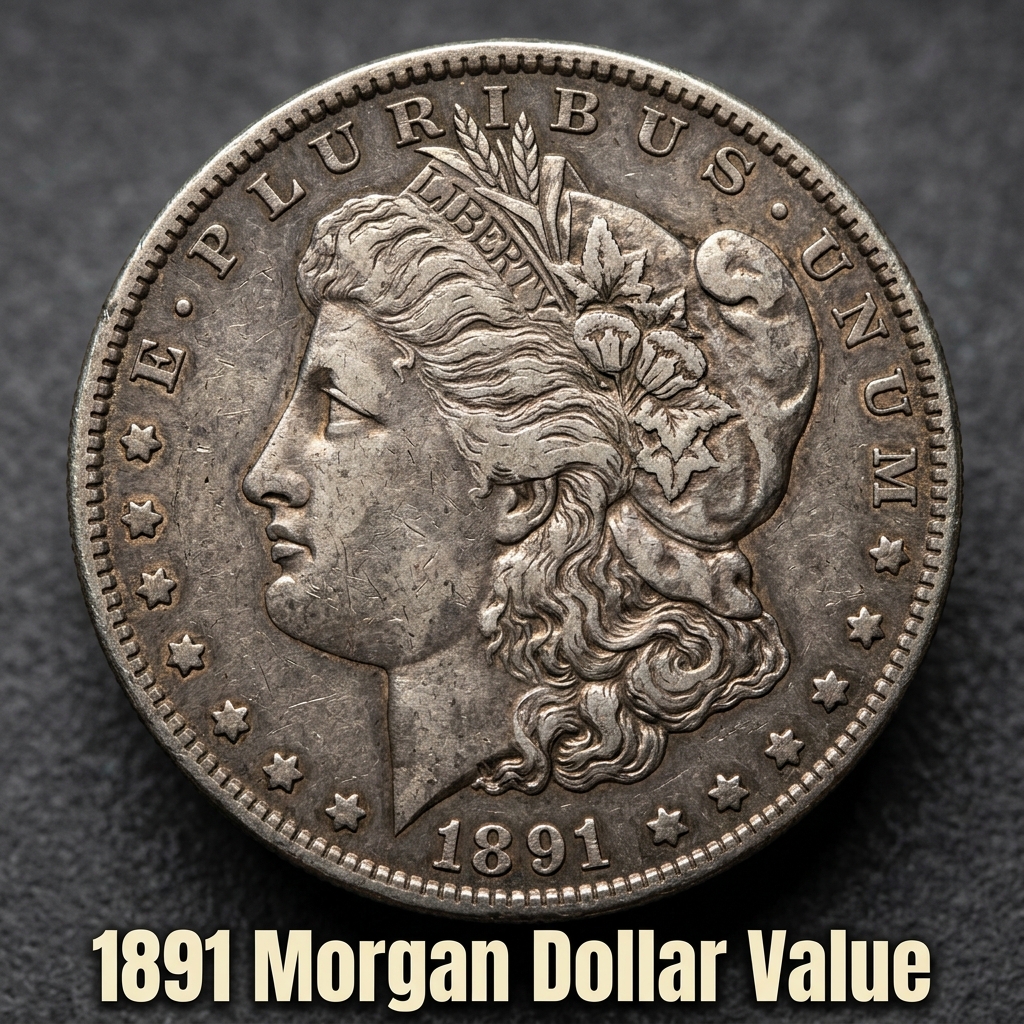
The 1891 Morgan Dollar is worth anywhere from $30 in heavily worn condition to well over $1,000 or more in high mint state grades. If you’ve got one of these old silver dollars sitting in a drawer or inherited from a relative, you’re holding a genuinely valuable piece of American history — and this guide will help you figure out exactly what it’s worth.
If you’re not sure whether your coin is actually an 1891 Morgan Dollar, you can use a free coin identification app to snap a photo and get an instant ID before diving into the value research.
—
What Makes the 1891 Morgan Dollar Special
The 1891 Morgan Dollar was struck at three different U.S. Mint facilities: Philadelphia (no mintmark), New Orleans (O mintmark), and San Francisco (S mintmark). Each mint produced coins with slightly different quality levels and mintage numbers, which directly affects what your coin is worth today.
The Philadelphia Mint produced about 8.69 million coins that year. New Orleans turned out 7.95 million, while San Francisco produced 5.29 million — making the 1891-S the slightly scarcer issue of the three. The designer was George T. Morgan, whose initial “M” appears at the base of Liberty’s neck on the obverse. These coins are 90% silver and weigh 26.73 grams, giving them an inherent silver melt value even in the worst condition.
Even a heavily worn 1891 Morgan Dollar contains roughly 0.7734 troy ounces of silver, so the coin’s base value rises and falls with the silver market. Right now, that puts the floor on any 1891 Morgan Dollar at around $20–$25 just for the metal alone.
—
1891 Morgan Dollar Value by Grade and Mint
The mintmark is one of the most important factors in determining value. Here’s a look at approximate retail values across different grades:
| Variety | Good (G-4) | Fine (F-12) | XF-40 | MS-63 | MS-65 |
|---|---|---|---|---|---|
| 1891 (Philadelphia) | $32 | $38 | $60 | $275 | $3,500+ |
| 1891-O (New Orleans) | $32 | $40 | $70 | $450 | $12,000+ |
| 1891-S (San Francisco) | $35 | $42 | $75 | $350 | $5,500+ |
For the most up-to-date pricing across all grades, you can check the 1891 Morgan Dollar price data on CoinHix, which tracks real auction results and dealer prices in real time.
—
How Condition Affects Your 1891 Morgan Dollar’s Worth
Coin condition — or “grade” in collector terms — is the single biggest factor separating a $35 coin from a $3,500 coin. Morgan Dollars that circulated heavily pick up contact marks, worn high points, and dull luster. Once a coin drops into the “Good” range, you can barely make out fine details on Liberty’s hair or the eagle’s feathers.
Coins that were saved immediately after minting and never spent are called “Mint State” or uncirculated coins. These are the ones that command serious money. In MS-63, your 1891 Morgan still has some surface marks, but retains its original mint luster. Jump up to MS-65 and you’re looking at a coin with nearly flawless surfaces and full, blazing luster — that’s where values can climb into the thousands.
Don’t clean your coin. This is the number one mistake people make. Even a gentle polishing can permanently reduce a coin’s grade and cut its value in half or more. If you think your coin might be uncirculated, have it evaluated by a professional grading service like PCGS or NGC before doing anything else.
CoinHix makes it easy to track current Morgan Dollar prices across every grade level, so you always know what the market looks like before buying or selling.
—
Special Varieties Worth Looking For
Beyond the three standard mint issues, there’s one notable variety that serious collectors hunt for: the 1891-O “Micro O” variety. This coin features a smaller-than-normal “O” mintmark punched into the die, and it commands a meaningful premium over standard 1891-O values.
There’s also a scarce proof version of the 1891 Morgan Dollar. The Philadelphia Mint struck only 650 proof coins that year for collectors. A proof 1891 Morgan in pristine condition can sell for $5,000 to $10,000 or more at major auctions.
You can find a more detailed breakdown of 1891 silver dollar values including varieties and proof versions if you want to dig deeper into the specific factors that could push your coin’s price higher.
—
Where to Sell Your 1891 Morgan Dollar
Once you know what you have, selling is the next step. Your main options are:
– Local coin shops — Fast and easy, but expect offers around 60–70% of retail value
– Online auctions (eBay, Heritage Auctions) — Wider audience, often better prices for nicer coins
– Coin shows — Great for getting multiple offers in one place
– Online dealers — Convenient, but always compare a few quotes
For worn circulated examples, a local shop is perfectly fine. For anything grading XF or above — especially uncirculated coins — it’s worth getting the coin professionally graded first to maximize your return. CoinHix can help you monitor recent sale prices so you walk into any negotiation knowing the real market value.
—
FAQ
Q: How do I find the mintmark on my 1891 Morgan Dollar?
A: Flip the coin over to the reverse (eagle) side and look just above the “DO” in DOLLAR at the bottom center of the coin. You’ll see either an “O” (New Orleans), “S” (San Francisco), or nothing at all (Philadelphia).
Q: Is my 1891 Morgan Dollar real silver?
A: Yes. All 1891 Morgan Dollars are made of 90% silver and 10% copper. The coin contains 0.7734 troy ounces of pure silver, giving it real intrinsic metal value regardless of its collector grade.
Q: Can I get my 1891 Morgan Dollar graded and how much does it cost?
A: Absolutely. PCGS and NGC are the two most trusted grading services. Fees typically start around $30–$50 per coin for standard service, though faster turnaround options cost more. Grading is especially worthwhile if your coin appears to be uncirculated, since a verified high-grade coin can be worth many times more than an ungraded one.