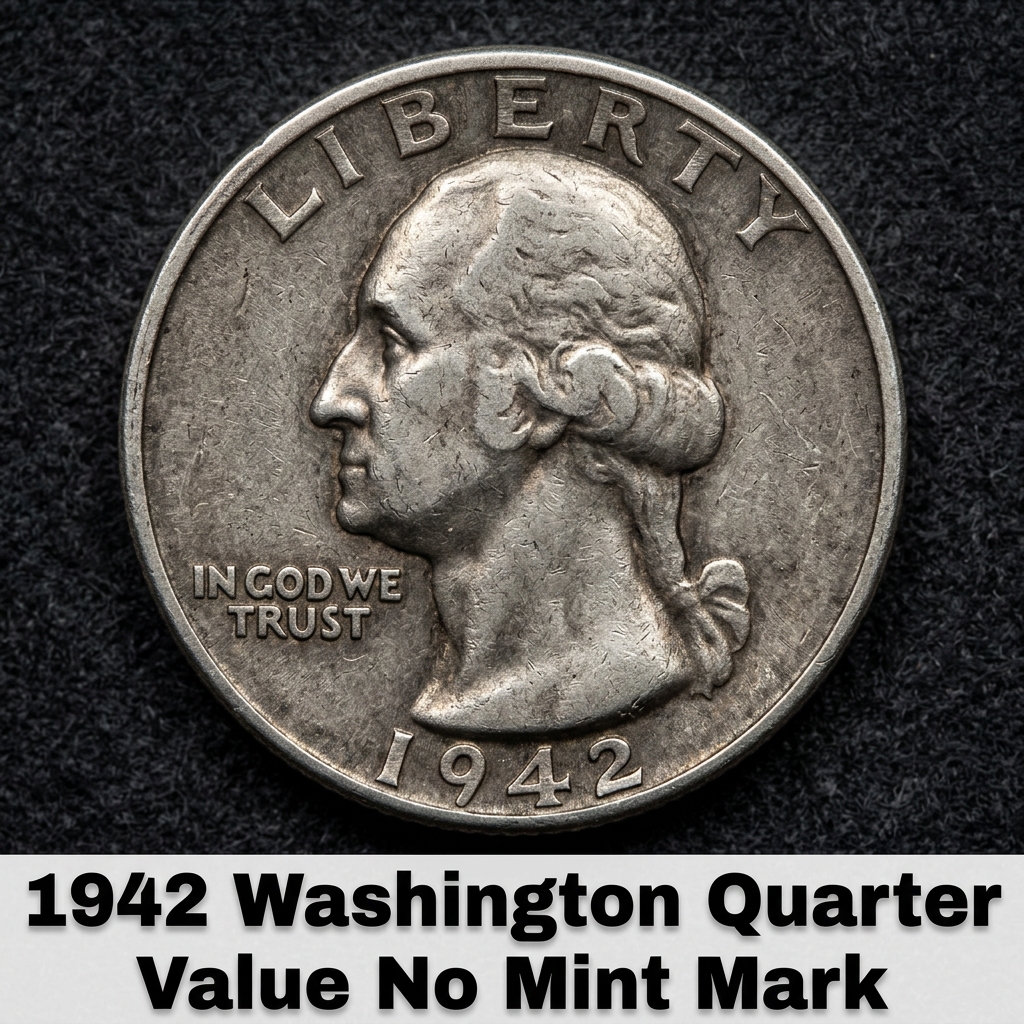
The 1942 Washington Quarter with no mint mark is worth anywhere from $5 in heavily worn condition to over $200 or more in high mint state grades — and if you’ve got a well-preserved example, you might be sitting on a surprisingly valuable coin.
If you found one of these in an old coin jar, a drawer, or inherited it from a relative, you’re in the right place. This guide will walk you through everything you need to know about its value, condition grades, and what makes certain examples worth real money. You can also use a free coin identification app to get a quick look at what you’ve got before diving deeper.
What Is the 1942 Washington Quarter No Mint Mark?
The 1942 Washington Quarter with no mint mark was struck at the Philadelphia Mint. Back in those days, Philadelphia didn’t add a mint mark to its coins — that only changed much later. So if your 1942 quarter has no letter under the eagle on the reverse, it came from Philly.
The U.S. Mint produced over 102 million of these quarters in 1942, making it a relatively common date in the Washington Quarter series. But “common” doesn’t always mean “worthless.” These coins are made of 90% silver, which alone gives them an intrinsic metal value of roughly $4 to $6 depending on current silver prices. Add numismatic (collector) value on top of that, and the picture gets more interesting fast.
The obverse shows George Washington’s portrait designed by John Flanagan, and the reverse displays an eagle with outstretched wings. It’s a classic American design that collectors have loved for decades.
1942 Washington Quarter No Mint Mark Value by Grade
Condition is everything when it comes to coin value. A coin that’s been rattling around in someone’s pocket for 80 years will look very different from one that’s been carefully stored. Here’s a simple breakdown of typical values:
| Grade | Description | Estimated Value |
|---|---|---|
| Good (G-4) | Heavy wear, design visible but flat | $5 – $7 |
| Very Fine (VF-20) | Moderate wear, major details clear | $7 – $10 |
| Extremely Fine (EF-40) | Light wear on high points | $10 – $18 |
| About Uncirculated (AU-55) | Slight wear, most luster present | $20 – $35 |
| Mint State (MS-63) | Uncirculated, some blemishes | $40 – $75 |
| Mint State (MS-65) | Gem uncirculated, strong luster | $100 – $200+ |
For the most up-to-date pricing data by grade, you can check the 1942 Washington Quarter price guide on CoinHix, which tracks real auction results and market trends.
Silver Content and Melt Value
One of the biggest reasons people hold onto old Washington Quarters is the silver. Every 1942 quarter — no mint mark or otherwise — contains 0.1808 troy ounces of pure silver. With silver prices fluctuating around $25 to $30 per troy ounce in recent years, the melt value alone sits somewhere between $4.50 and $5.50.
That means even your most worn-out 1942 quarter is worth more than face value just for the metal inside. It’s never going to be worth 25 cents to a serious collector or silver buyer. This silver base is the floor of the coin’s value, and condition and collector demand build on top of it from there.
If you want a full breakdown of the 1942 quarter’s value including silver melt and collector grades, there are some excellent resources online that combine current silver prices with numismatic data.
How to Tell If Your 1942 Quarter Is Worth More
Not every 1942 Washington Quarter is created equal. A few things can make your coin stand out:
Strike quality — Some Philadelphia Mint coins from 1942 were weakly struck, especially on the eagle’s breast feathers. A sharply struck example is more desirable to collectors.
Luster — Uncirculated coins with original, full, flashy luster are worth significantly more than dull or cleaned examples.
No cleaning — This is huge. A lot of old coins were cleaned by well-meaning owners trying to make them “look nice.” Cleaning actually destroys the natural surface and drastically reduces value. If your coin looks unnaturally shiny or has hairline scratches under magnification, it’s probably been cleaned.
Toning — Natural, attractive toning can sometimes add value. Artificial or ugly toning does not.
Using CoinHix to compare photos of your coin against graded examples is a great way to get a rough sense of where yours falls. The CoinHix app makes this especially easy if you’re doing this on the go.
Should You Get It Graded?
If your 1942 Washington Quarter looks like it hasn’t been touched since it left the mint — sharp details, no wear, original luster — it might be worth submitting to a professional grading service like PCGS or NGC. Coins that grade MS-65 or higher can be worth well over $100, and having a certified grade protects you if you ever want to sell.
For circulated coins in the $5–$20 range, professional grading usually isn’t cost-effective since fees can eat into or exceed the coin’s value. In that case, knowing the approximate grade yourself is good enough.
Frequently Asked Questions
Q: Is a 1942 quarter with no mint mark valuable?
A: Yes, to a degree. All 1942 Washington Quarters without a mint mark are made of 90% silver, giving them an intrinsic value above face value. Circulated examples typically sell for $5–$20, while gem uncirculated coins can reach $100–$200 or more.
Q: How do I know if my 1942 quarter is in good condition?
A: Look at the high points of the design — Washington’s cheekbone and hair, and the eagle’s breast feathers. If these areas are smooth and worn flat, it’s heavily circulated. If the design is sharp with visible luster, it may grade AU or Mint State. You can use CoinHix to compare your coin to graded examples for a clearer picture.
Q: Where can I sell my 1942 Washington Quarter?
A: Common options include eBay, local coin shops, coin shows, and online auction platforms. For silver value alone, many precious metals dealers and pawn shops will buy them. If you have a high-grade example, consider PCGS or NGC certification first to maximize what you get at auction.