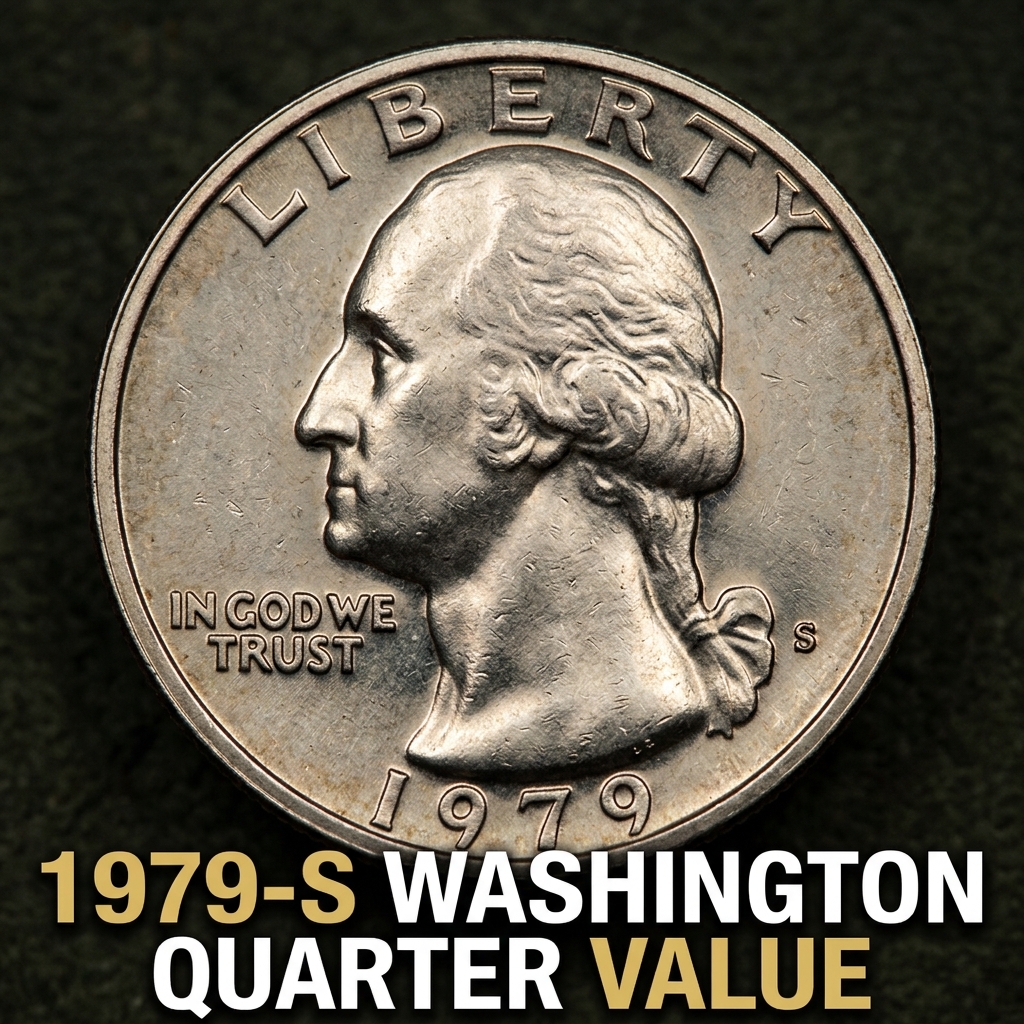
The 1979-S Washington Quarter is worth anywhere from $1 in average circulated condition to well over $10 in pristine proof quality — and certain rare varieties can command hundreds of dollars from serious collectors. If you found one of these coins and want to know its true value, you’re in the right place.
What Is the 1979-S Washington Quarter?
The 1979-S Washington Quarter was minted exclusively at the San Francisco Mint and was never released into general circulation. That “S” mintmark tells you this coin was struck as a proof coin — a specially made collectible edition produced with polished dies and mirrored planchet surfaces. These coins were sold directly to collectors in official U.S. Mint proof sets. So if you’ve come across one, it likely came from an old proof set someone put away decades ago. To quickly identify your coin and check its details, you can use a free coin identification app right from your phone — a great starting point before diving into valuation.
The 1979-S comes in two distinct varieties: the Type 1 (filled S) and the Type 2 (clear S). This difference in the mintmark style is what separates a common proof coin from a genuinely sought-after collectible. Most people don’t realize how much that tiny detail matters — but to a seasoned collector, it’s everything.
Understanding the Two Types and Their Values
Here’s where things get interesting. In 1979, the San Francisco Mint used two different mintmark punches throughout the year. The first punch had a slightly filled or “blobby” appearance — this is the Type 1. Later in the year, a new, crisper mintmark punch was introduced, producing the Type 2, which shows a much cleaner, more defined “S.”
The Type 1 is far more common. It was used in the majority of proof sets that year, meaning millions were made. The Type 2 is significantly scarcer, and that scarcity drives its value up considerably for collectors.
For detailed 1979-S Washington Quarter price data across multiple grades and varieties, checking a reputable coin pricing resource is always a smart move before buying or selling.
| Variety | Grade / Condition | Estimated Value |
|---|---|---|
| Type 1 (Filled S) | PR-65 | $2 – $5 |
| Type 1 (Filled S) | PR-69 DCAM | $15 – $40 |
| Type 2 (Clear S) | PR-65 | $30 – $60 |
| Type 2 (Clear S) | PR-69 DCAM | $200 – $500+ |
How Condition Affects the 1979-S Quarter’s Worth
Even though these coins were made as proofs and were never meant to circulate, condition still matters enormously. Proof coins are graded on the same 70-point Sheldon scale used for all U.S. coins, but they’re also evaluated for their “cameo” contrast — that frosted portrait against a mirror-like background.
Coins that show strong cameo or deep cameo (DCAM) contrast are the most desirable. A PR-69 DCAM Type 2 can fetch several hundred dollars, while a PR-65 of the same type might sell for $30 to $60. Even small surface hairlines or fingerprints can dramatically reduce a coin’s grade and value.
If you want a reliable breakdown of what your 1979 quarter is worth based on its specific grade and condition, referencing an up-to-date coin value resource is highly recommended before making any decisions.
The CoinHix app is a fantastic tool for this — it lets you look up proof coin values quickly and compare prices across grades without needing to dig through old price guides.
Is It Worth Getting Your 1979-S Quarter Graded?
If you suspect you have a Type 2 variety in high condition, professional grading through PCGS or NGC could be worth the investment. A certified PR-69 DCAM Type 2 in a slab carries strong market credibility and typically sells for a significant premium over raw ungraded examples.
For most Type 1 coins in typical proof condition, however, the cost of grading may outweigh the potential return. Unless the coin is visually stunning, many collectors are happy to buy raw Type 1 examples at modest prices.
To easily identify which type you have and get an instant value estimate, CoinHix offers a user-friendly coin lookup tool that’s especially helpful for proof coin varieties. Many everyday collectors have discovered they were sitting on something far more valuable than they expected just by running a quick search.
Tips for Selling Your 1979-S Washington Quarter
If you’ve decided to sell, here are a few practical tips:
– eBay is one of the best places to sell proof coins because you can check recent “sold” listings to gauge real market prices.
– Coin shows and local dealers are good options if you want cash in hand quickly, though you may receive less than retail value.
– Online collector forums can connect you directly with buyers who know the value of what you’re offering.
– Always photograph your coin clearly before listing, especially the mintmark area.
– Consider using CoinHix to double-check current market trends before pricing your coin.
—
FAQ
Q: How do I tell if my 1979-S quarter is a Type 1 or Type 2?
A: Look closely at the “S” mintmark under magnification. A Type 1 has a slightly filled or blobby appearance, while the Type 2 has a crisp, clear, well-defined “S.” The difference is subtle but significant in terms of value.
Q: Is the 1979-S Washington Quarter made of silver?
A: No. The 1979-S Washington Quarter is made of a copper-nickel clad composition, not silver. The U.S. Mint stopped making silver quarters for circulation after 1964. However, proof sets from this era were also not silver unless specifically labeled as “Silver Proof Sets,” which the 1979 sets were not.
Q: Where can I find the most accurate current value for my 1979-S quarter?
A: The best approach is to check multiple sources — recent eBay sold listings, coin dealer price guides, and apps like CoinHix that aggregate real market data. This gives you a realistic picture of what buyers are actually paying today rather than outdated catalog prices.