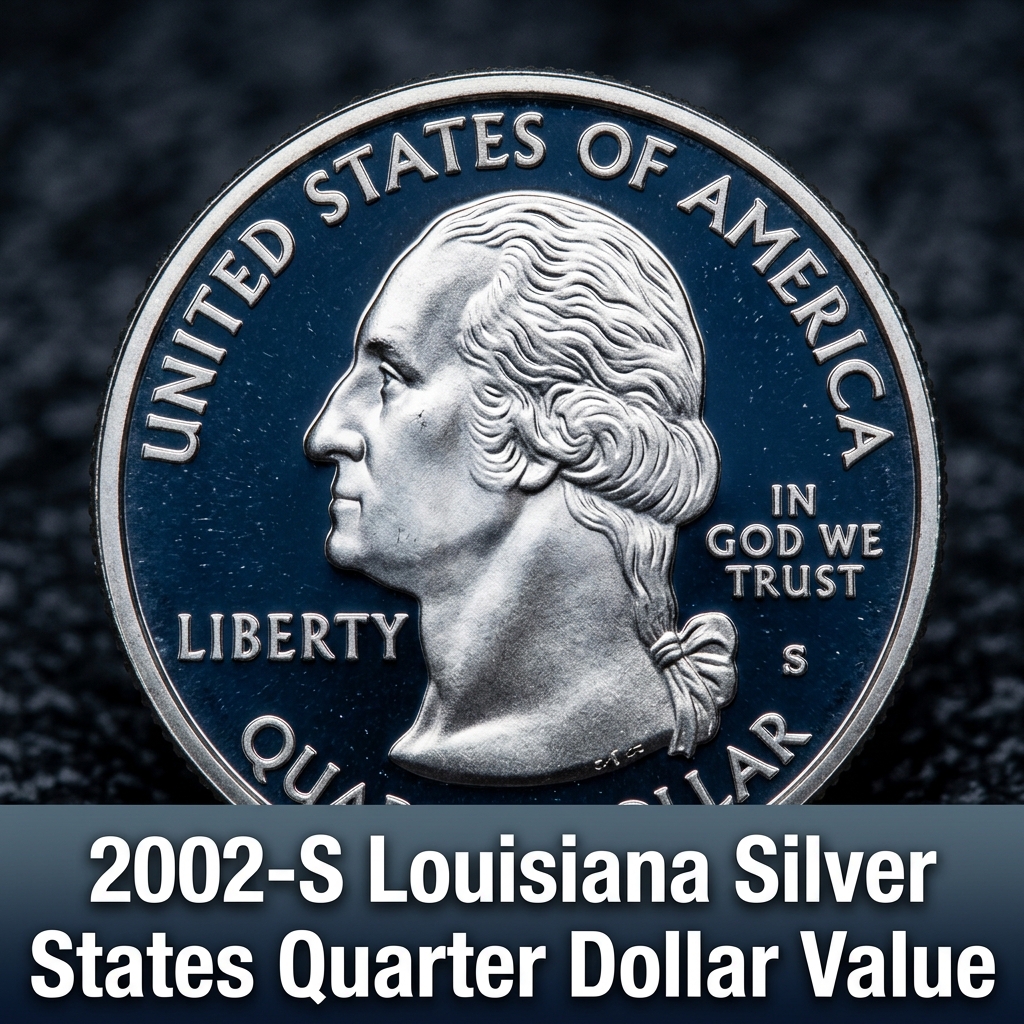
The 2002-S Louisiana Silver Proof Quarter is worth anywhere from $5 in lightly circulated condition to over $20 or more for top-grade examples, with some certified specimens fetching even higher prices among dedicated collectors. If you recently found one of these coins or inherited a proof set, you’re in the right place to find out exactly what it’s worth.
If you’re not sure whether the coin you’re holding is the silver version or the standard clad proof, a free coin identification app can help you quickly figure out what you’ve got before you decide whether to sell or hold onto it.
What Makes the 2002-S Louisiana Quarter Special
The 2002-S Louisiana Silver Proof Quarter was struck at the San Francisco Mint as part of the U.S. Mint’s Silver Proof Set program. Unlike the standard clad quarters most people carry in their pockets, these coins are composed of 90% silver and 10% copper — the same composition used in American coinage before 1965. That silver content alone gives them intrinsic metal value beyond their face value.
The Louisiana design features a pelican — the state bird — along with a trumpet and the phrase “Louisiana Purchase.” It’s a handsome design that many collectors enjoy adding to their State Quarters sets. The “S” mintmark on the obverse (front) just below Washington’s portrait is your signal that this was a San Francisco-struck proof coin, not a business strike meant for everyday spending.
Because these coins were only included in special proof sets sold directly to collectors, they were never released into general circulation. That means most surviving examples are in excellent condition. However, condition still matters a great deal when it comes to value.
2002-S Louisiana Silver Quarter Value by Grade
Proof coins are graded on the same 70-point Sheldon scale as regular coins, but they carry the “PR” (Proof) or “PF” designation rather than “MS.” Here’s a quick look at what these coins typically sell for across different grade levels:
| Grade | Description | Estimated Value |
|---|---|---|
| PR-65 | Gem Proof, minor blemishes | $5 – $8 |
| PR-67 | Superb Gem Proof | $8 – $12 |
| PR-68 | Near-perfect surfaces | $12 – $18 |
| PR-69 DCAM | Deep Cameo, exceptional contrast | $15 – $25 |
| PR-70 DCAM | Perfect grade, flawless | $30 – $60+ |
Values can shift with silver spot prices and collector demand. For real-time and historical pricing on similar State Quarter proof coins, you can browse certified auction records and price data for 2002 State Quarter issues to get a sense of where the market stands.
Silver Value vs. Collector Premium
One thing that sets the 2002-S Louisiana Silver Quarter apart from its clad cousin is the silver melt value. Each coin contains approximately 0.1808 troy ounces of pure silver. When silver is trading around $25 per troy ounce (a rough midpoint for recent years), the melt value alone comes out to roughly $4.50. That means even a heavily worn or damaged example retains meaningful intrinsic value — it’s never truly “worthless” the way a clad quarter might feel.
Of course, for coins in top proof grades — especially those graded PR-69 DCAM or PR-70 DCAM by PCGS or NGC — the collector premium far exceeds the silver melt value. Cameo contrast (the frosted design against a mirror-like field) is a key factor graders look for in proof coins, and Deep Cameo (DCAM) designations command noticeably higher prices.
CoinHix is one of the most useful tools available for tracking these kinds of market shifts, giving collectors and casual sellers alike up-to-date price data across thousands of coin types.
How to Tell If You Have the Silver Version
This is one of the most common questions people ask when they find a 2002-S quarter. There were actually two types of proof quarters produced at San Francisco in 2002: the standard clad proof (copper-nickel over copper) and the 90% silver proof. They look almost identical at a glance.
The easiest test is to look at the edge of the coin. Clad quarters show a copper-colored stripe along the edge, while silver quarters appear uniformly silver all the way through. You can also weigh them: the silver version weighs 6.25 grams versus 5.67 grams for the clad. A small precision scale — the kind sold for around $10 online — is a worthwhile investment if you’re sorting through a proof set.
For a more detailed breakdown of what your 2002 quarter is worth based on type and condition, that resource offers straightforward guidance for everyday collectors and sellers.
Should You Get It Certified?
For most 2002-S Louisiana Silver Quarters in average proof condition, professional grading by PCGS or NGC probably isn’t worth the cost. Certification fees typically start around $20–$30 per coin, which would eat into or exceed the coin’s market value at lower grades.
However, if you have a coin that looks absolutely pristine — brilliant mirrors, strong cameo contrast, no visible marks — it might be worth submitting. A PR-70 DCAM example certified by a top grading service can sell for $40–$60 or more, making the submission cost worthwhile.
CoinHix makes it easy to compare raw and certified prices side by side, so you can make an informed decision before spending money on grading. And if you’re just getting started with coin collecting or evaluation, CoinHix is a great place to learn the basics alongside its pricing tools.
FAQ
Q: Is the 2002-S Louisiana Quarter made of real silver?
A: Yes — the 2002-S Louisiana Silver Proof Quarter is composed of 90% silver and 10% copper, giving it genuine silver melt value in addition to any collector premium.
Q: How do I know if my 2002-S quarter is silver or clad?
A: Check the edge of the coin. A silver quarter will have a uniform silver-colored edge with no visible copper stripe. You can also weigh it — the silver version weighs 6.25 grams, while the clad proof weighs 5.67 grams.
Q: Where is the best place to sell a 2002-S Louisiana Silver Quarter?
A: eBay is a popular option for common proof coins like this one, as you can easily compare recent sold listings. Coin shows and local dealers are also good options. For certified high-grade examples, major auction houses like Heritage Auctions or Stack’s Bowers may be worth considering.