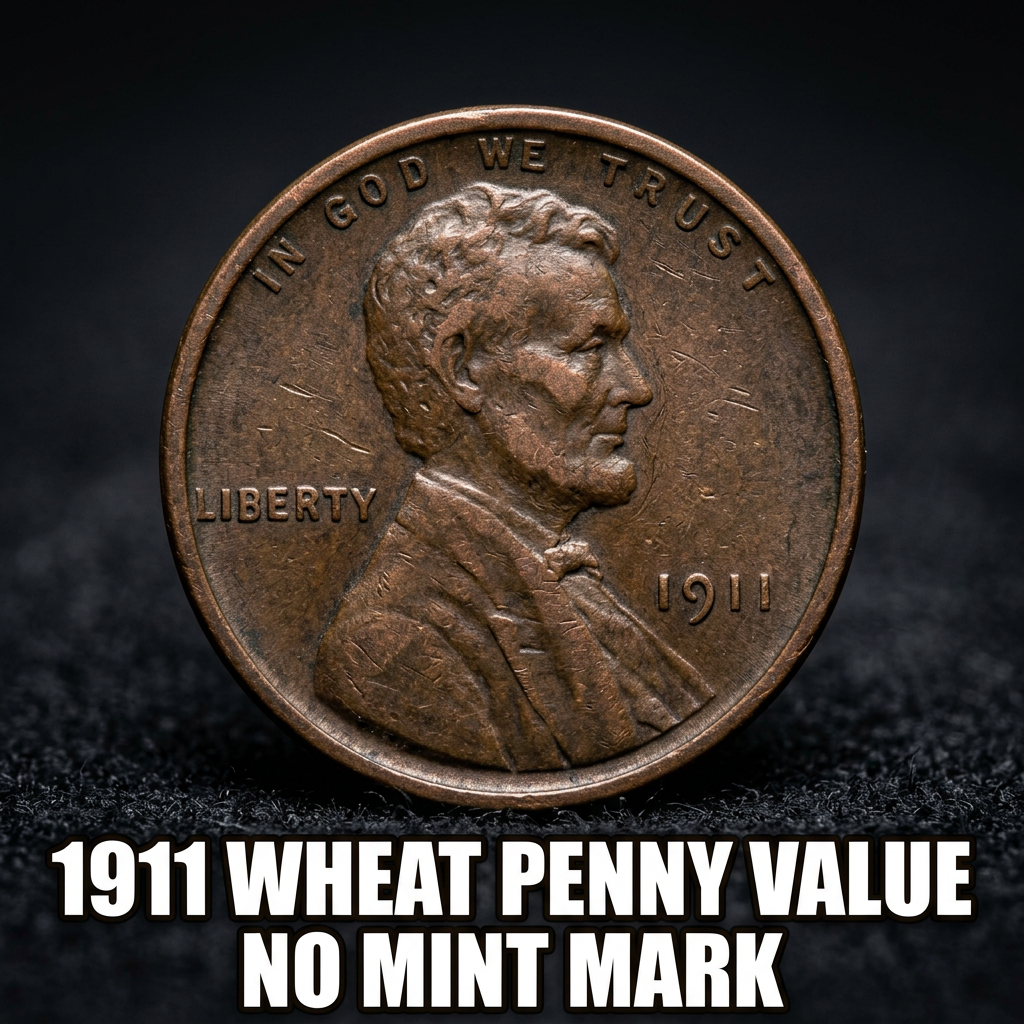
The 1911 Wheat Penny with no mint mark is worth anywhere from $0.50 in heavily worn condition to over $100 or more in high-grade mint state. If you found one of these old Lincoln cents in a jar, a wallet, or a family collection, you might be sitting on a little piece of history — and some real money.
If you’re not sure what coin you’re holding, you can use a free coin identification app to snap a photo and get instant results. Tools like this make it easy for everyday people to figure out exactly what they have before heading to a dealer.
What Is the 1911 Wheat Penny No Mint Mark?
The 1911 Lincoln Wheat Penny with no mint mark was struck at the Philadelphia Mint, which was standard practice at the time — Philadelphia didn’t add a mint mark to cents back then. This was only the third year of the Lincoln cent series, which launched in 1909 to celebrate the 100th anniversary of Abraham Lincoln’s birth. The coin features Victor David Brenner’s classic portrait of Lincoln on the obverse and two wheat stalks framing the words “ONE CENT” on the reverse.
In 1911, the Philadelphia Mint produced approximately 101,177,787 Lincoln cents without a mint mark. That’s a large mintage, which is part of why this coin is relatively affordable compared to some rarer dates in the series. Still, condition plays a huge role in value, and well-preserved examples can command strong prices from collectors.
How Much Is a 1911 Wheat Penny Worth by Grade?
Coin value depends heavily on condition, or “grade” in collector terms. A heavily circulated 1911 no mint mark penny that’s worn smooth might only fetch $0.50 to $1. But as the grade climbs, so does the price. For the most current pricing data, you can check out detailed 1911 Wheat Penny price data by grade and condition to see exactly where your coin falls on the value scale.
Here’s a general breakdown of typical retail values:
| Grade | Description | Estimated Value |
|---|---|---|
| Good (G-4) | Heavy wear, design visible | $0.50 – $1.50 |
| Fine (F-12) | Moderate wear, most details clear | $2 – $5 |
| Extremely Fine (EF-40) | Light wear on high points | $10 – $20 |
| Mint State (MS-63) | Uncirculated, some marks | $40 – $75 |
| Mint State (MS-65 RD) | Gem uncirculated, full red color | $125 – $200+ |
What Makes a 1911 Penny More Valuable?
Several factors push the value of a 1911 no mint mark Wheat Penny higher. The biggest is color. Uncirculated copper coins are graded as Red (RD), Red-Brown (RB), or Brown (BN). Full Red examples — those that have retained their original bright copper luster — are the most desirable and command the highest premiums. A gem MS-65 Red 1911 cent can easily sell for $150 or more at auction.
Strike quality and surface preservation also matter. Any coin with sharp details, no cleaning, and no environmental damage is going to be worth more. Collectors pay a big premium for originality. If your coin has been cleaned with chemicals or polished, it will lose value even if it looks shiny — experienced collectors and dealers can always tell. You can explore more about the full 1911 penny value guide including mint marks and special varieties to better understand all the variables at play.
How to Check Your 1911 Wheat Penny at Home
You don’t need to be an expert to get started. First, look at the reverse of the coin for a mint mark — the 1911 Philadelphia cent has none, while San Francisco coins show an “S” and Denver coins show a “D.” Next, assess the wear level honestly. Can you see Lincoln’s hair strands and ear details clearly? What about the wheat stalks on the back?
This is where CoinHix becomes a valuable tool. The CoinHix app lets you look up coin values by date, mint mark, and grade — all from your phone. It’s an easy way to get a realistic idea of what your coin is worth before you visit a coin shop or list it online.
Should You Sell or Keep Your 1911 Wheat Penny?
If your coin is in circulated condition, it’s a fun piece of history but not a major windfall. However, if it’s uncirculated or shows strong Red color, it could be worth taking seriously. Consider getting it graded by PCGS or NGC if you believe it’s a high-grade example — professional grading adds credibility and often increases sale prices significantly.
Either way, apps like CoinHix make it simple to track your collection’s value over time. Whether you’re a casual finder or a growing collector, having the right tools in your pocket helps you make smarter decisions about your coins.
—
Frequently Asked Questions
Q: How do I know if my 1911 penny is the Philadelphia version?
A: Look at the reverse of the coin just below the date area and above the wheat stalks — there will be no mint mark. The Philadelphia Mint did not add a “P” to Lincoln cents during this era, so a blank space confirms it’s a Philadelphia coin.
Q: Is a cleaned 1911 Wheat Penny still worth anything?
A: Yes, but significantly less than an original, uncleaned example. Cleaning removes natural patina and leaves hairline scratches visible under magnification. Most dealers and collectors discount cleaned coins heavily, even if they look bright and shiny to the naked eye.
Q: What’s the most valuable version of the 1911 Lincoln cent?
A: The 1911-S (San Francisco) is the key date of the three 1911 varieties, with a much lower mintage of about 4 million coins. It’s considerably rarer and more valuable than the Philadelphia no mint mark coin. In high grades, a 1911-S can be worth thousands of dollars.