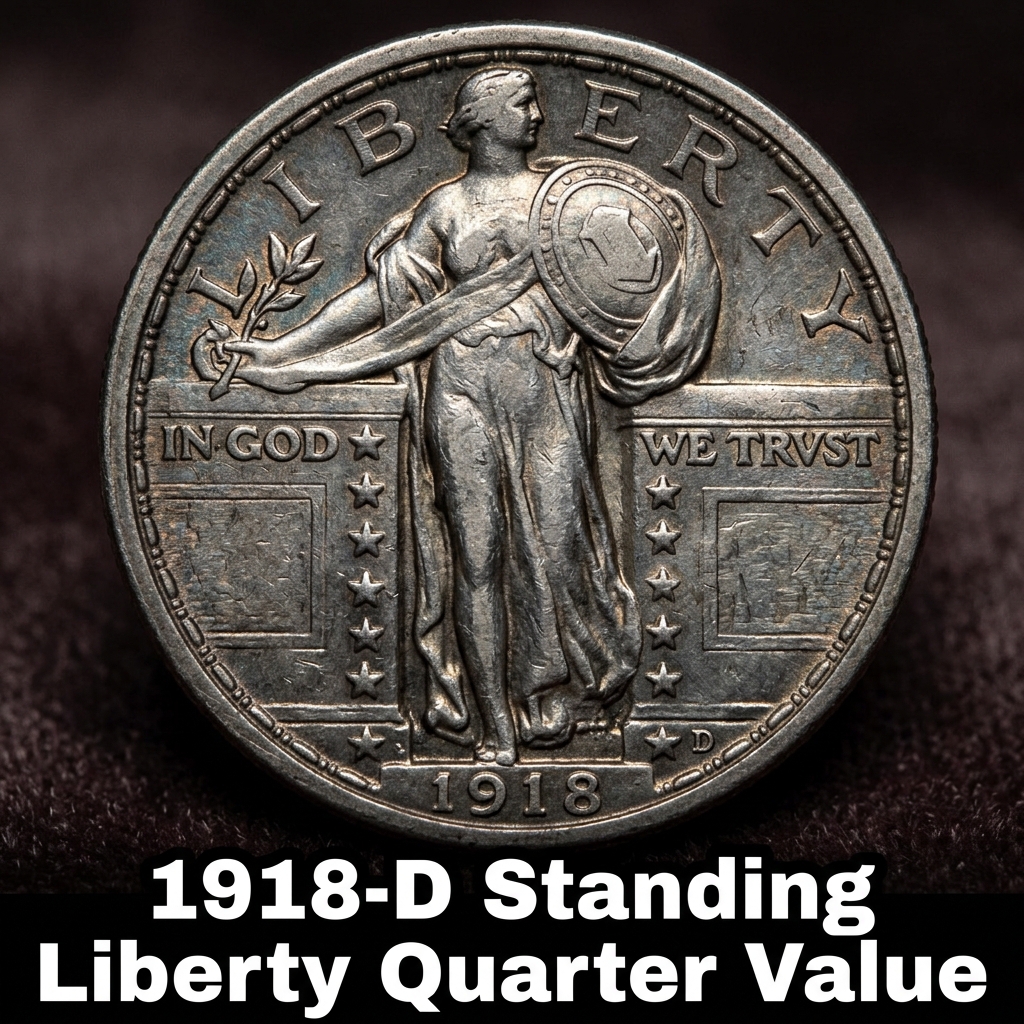
The 1918-D Standing Liberty Quarter is worth anywhere from $20 in heavily worn condition to well over $2,000 in high mint state grades. If you’ve pulled one of these Denver-mint coins out of an old collection or coin jar, you may be sitting on something quite valuable. Read on to find out exactly what yours might be worth.
If you’re not sure whether the coin in your hand is actually a 1918-D Standing Liberty Quarter, you can use a free coin identification app to confirm the date, mintmark, and series before you dig into the value details. Once you’re confident in the identification, this guide will walk you through everything you need to know.
What Makes the 1918-D Standing Liberty Quarter Special
The Standing Liberty Quarter series ran from 1916 to 1930, and it remains one of the most beloved designs in American coinage history. Sculptor Hermon Atkins MacNeil created the design, featuring a full-length figure of Liberty standing in a gateway, flanked by shields and olive branches. The 1918-D was struck at the Denver Mint and carries the “D” mintmark on the obverse, just to the right of the date.
What sets this coin apart is a combination of historical timing and collector demand. The year 1918 was a pivotal moment in American history — World War I was coming to a close — and coins minted during that era carry a kind of historical weight that resonates with collectors. The Denver Mint produced around 7,400,000 of these quarters in 1918, making it a moderately available coin, but high-grade examples are genuinely scarce and command serious premiums at auction.
The Type 2 design, introduced in 1917, features a chain mail covering on Liberty’s chest (earlier 1916 and early 1917 coins showed a bare-breasted figure). By 1918, all Standing Liberty Quarters used the Type 2 design, so the 1918-D falls into this category.
1918-D Standing Liberty Quarter Value by Grade
Coin value is almost entirely determined by condition, or “grade.” A coin that has been circulated heavily will show significant wear on Liberty’s head and the high points of her figure, while a coin that spent time in a collection rather than a pocket will show far more detail and luster.
Here’s a general value breakdown for the 1918-D Standing Liberty Quarter:
| Grade | Description | Approximate Value |
|---|---|---|
| G-4 (Good) | Heavily worn, date visible | $20 – $30 |
| VG-8 (Very Good) | Major features clear | $30 – $50 |
| F-12 (Fine) | Moderate wear, detail visible | $50 – $80 |
| VF-20 (Very Fine) | Light to moderate wear | $80 – $150 |
| EF-40 (Extremely Fine) | Slight wear on high points | $150 – $300 |
| MS-63 (Mint State) | Uncirculated, some marks | $600 – $1,200 |
| MS-65 (Gem Mint State) | Nearly perfect surfaces | $2,000+ |
For the most up-to-date market data, you can check the 1918-D Standing Liberty Quarter price trends across mint state grades to see how recent auction results compare to these estimates.
How to Grade Your 1918-D Standing Liberty Quarter at Home
You don’t need to be a professional numismatist to get a rough sense of your coin’s grade. Start by examining Liberty’s head — this is the first spot to show wear on Standing Liberty Quarters. If the details in her hair are mostly flat and smooth, you’re likely looking at a Good or Very Good coin. If you can see individual hair strands clearly, you’re probably in Fine to Very Fine territory.
Next, check the shield on the left side of the coin and the eagle on the reverse. In higher grades, the feathers on the eagle’s breast will be distinct and separated. In lower grades, they’ll blend together.
Use a magnifying glass if you have one, and view the coin under good lighting at an angle to spot any remaining luster — that soft, cartwheel-like shine that indicates a coin has never been heavily circulated. If you see that shine, your 1918-D could be worth significantly more than a circulated example.
CoinHix makes this process easier for beginners. The CoinHix app lets you compare your coin’s surfaces to graded examples in their database, giving you a starting point before you take it to a dealer.
Where to Sell or Get an Appraisal for Your 1918-D Quarter
Once you have a rough idea of your coin’s condition, you have several options for selling or getting a professional opinion. Local coin dealers are a good first stop — most will offer a free verbal appraisal, though their buy prices will reflect a dealer margin. Online platforms like eBay, Heritage Auctions, and PCGS CoinFacts are also useful for comparing recent sales of similar coins.
If your coin grades EF-40 or higher, it’s worth considering professional certification through PCGS or NGC. A certified coin in a graded slab typically sells for more than a raw (uncertified) coin of the same quality, because buyers trust the independent grade.
For a quick reference on what similar coins have sold for recently, the detailed 1918 quarter value breakdown by date and mintmark is a helpful resource that tracks real market prices across different grades and mint facilities.
You can also use CoinHix to scan recent completed sales and get a realistic sense of what your specific coin might fetch in today’s market before you commit to a buyer.
FAQ About the 1918-D Standing Liberty Quarter
Q: How do I know if my quarter is a 1918-D and not a 1918-S or 1918 Philadelphia?
A: Look for the mintmark on the obverse (front) of the coin, just to the right of the date. A “D” indicates Denver, an “S” indicates San Francisco, and no mintmark means it was struck in Philadelphia. The 1918-P (no mintmark) had the highest mintage of the three, while the 1918-S is considered scarcer in top grades.
Q: Is the 1918-D Standing Liberty Quarter silver?
A: Yes. Standing Liberty Quarters are composed of 90% silver and 10% copper. Even a heavily worn example contains approximately 0.1808 troy ounces of silver, which gives it a base melt value tied to the current silver spot price. As of recent silver prices, that melt value alone is typically around $4–$5, though numismatic (collector) value far exceeds that in most grades.
Q: What should I do if my 1918-D has a full head (FH) designation?
A: A “Full Head” designation means the three leaves and the helmet details on Liberty’s head are fully struck and clearly defined. This is a significant premium feature on Standing Liberty Quarters. A 1918-D with FH certified by PCGS or NGC can be worth several times more than a standard example in the same grade. If you think your coin might qualify, have it professionally graded before selling.