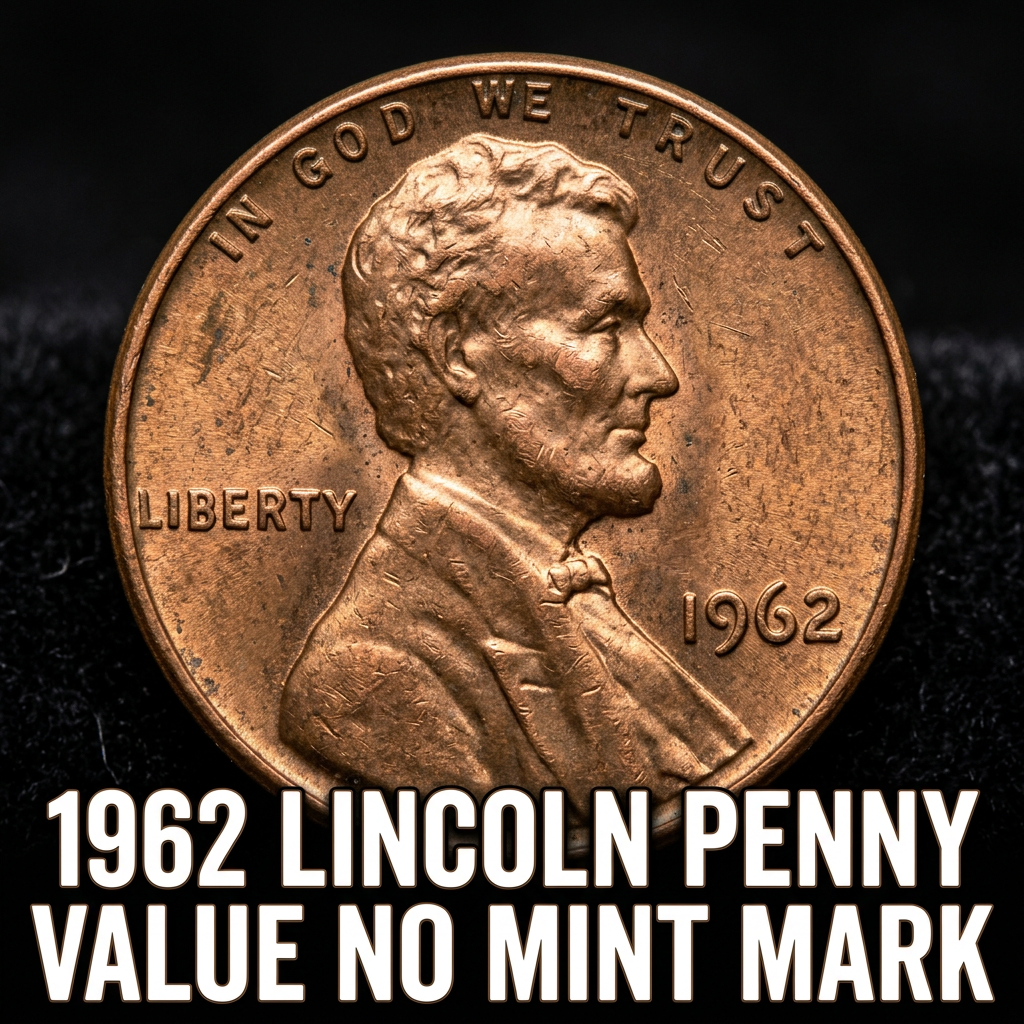
The 1962 Lincoln Penny with no mint mark is worth anywhere from 1 cent in heavily worn condition to over $10 or more in pristine mint state, with certain high-grade examples fetching $20 to $50 among serious collectors. If you just found one of these coins in an old jar or inherited a collection, you might be surprised at what it could be worth.
What Does “No Mint Mark” Mean on a 1962 Penny?
If you’re new to coin collecting, the mint mark is a small letter stamped on a coin that tells you where it was made. In 1962, the United States had two mints producing Lincoln cents: Philadelphia and Denver. Coins from Denver carry a small “D” on the obverse (front) just below the date. Coins from Philadelphia — the no mint mark variety — were produced without any letter at all. That’s simply how Philadelphia marked its coins until 1980.
So when you see a 1962 Lincoln Penny with no mint mark, it came from the Philadelphia Mint. That year, Philadelphia struck over 606 million of these coins, making them relatively common in circulated grades. But just because a coin is common doesn’t mean it’s worthless — condition is everything in numismatics.
To quickly identify your coin and get an estimate of its grade, try using a free coin identification app that can scan your penny and provide useful details right from your phone. It’s a great starting point for beginners.
1962 Lincoln Penny Value by Condition
The value of your 1962 penny no mint mark depends almost entirely on its condition, or “grade.” Here’s a breakdown of what collectors typically pay:
| Grade | Description | Estimated Value |
|---|---|---|
| Good (G-4) | Heavily worn, main details visible | $0.01 – $0.05 |
| Fine (F-12) | Moderate wear, lettering clear | $0.05 – $0.10 |
| Extremely Fine (EF-40) | Light wear on high points | $0.25 – $0.50 |
| Uncirculated (MS-60 to MS-63) | No wear, some contact marks | $1 – $5 |
| Gem Uncirculated (MS-65 Red) | Sharp strike, full original red luster | $10 – $50+ |
For a closer look at current 1962 Lincoln Penny MS-RD price data and recent auction results, you’ll find that gem red examples regularly outperform expectations at auction. CoinHix is one of the most reliable tools for tracking these real-time coin values.
Why Color Matters So Much for 1962 Pennies
One thing that surprises many first-time sellers is that Lincoln cents from this era are graded not just by wear, but also by color. Since these coins were struck in 95% copper, they naturally develop toning over time. Graders use three color designations:
– Red (RD): The coin retains 95% or more of its original copper-red luster. This is the most valuable designation.
– Red-Brown (RB): A mix of original red and natural brown toning. Mid-range value.
– Brown (BN): Fully toned brown. Still collectible but worth significantly less than red examples.
A 1962 penny graded MS-65 Red can be worth 10 times more than the same coin graded MS-65 Brown. That’s why storage matters — coins kept in protective holders away from air and humidity preserve their red color far longer.
If you want to explore the full spectrum of 1962 penny value information including red, red-brown, and brown designations, dedicated coin value resources break it down clearly by grade and color designation.
Proof Coins and Special Versions to Know About
In 1962, the Philadelphia Mint also produced proof Lincoln cents as part of official proof sets sold to collectors. These coins were struck with specially polished dies on polished planchets, giving them a mirror-like finish and sharply defined details. Proof 1962 pennies are still relatively affordable but are worth more than regular business strikes.
A 1962 Proof cent in PR-65 Red condition typically sells for around $5 to $12, while a PR-68 Deep Cameo example — with frosted devices against mirror-like fields — can fetch $50 to $150 or more. Around 3.2 million proof sets were sold that year, so these coins are available, but top-grade cameo examples are genuinely scarce.
Using CoinHix to monitor proof penny auction results can help you understand where the market is heading before you decide to sell or buy.
Tips for Getting the Best Value for Your 1962 Penny
Before you sell or toss your 1962 Lincoln cent, take a few steps to maximize its value. First, do not clean the coin — ever. Cleaning removes the natural surface and dramatically reduces value, even if it looks shinier afterward. Second, handle coins by their edges only to avoid adding fingerprints.
If your coin appears to be uncirculated with strong red color, consider having it professionally graded by PCGS or NGC. The cost of grading may be worth it for high-quality examples. For everyday worn coins, CoinHix and similar apps can give you a realistic ballpark before you invest in grading fees.
Finally, check major auction platforms and coin shows to see recent sale prices. The coin market shifts regularly, and knowing the current demand helps you time your sale wisely.
FAQ
Q: Is a 1962 penny with no mint mark rare?
A: No, the 1962 Philadelphia penny is one of the most common Lincoln cents from the era, with over 606 million minted. However, high-grade examples with full red color are genuinely scarce and can carry significant premiums.
Q: How do I know if my 1962 penny is worth grading?
A: If your coin shows no signs of wear, retains strong original red luster, and has no heavy marks or scratches, it may be worth submitting to PCGS or NGC. Coins grading MS-65 Red or higher can sell for $10 to $50 or more, making professional grading cost-effective.
Q: What is the most valuable 1962 Lincoln penny ever sold?
A: Top-population examples graded MS-67+ Red by major grading services have sold for several hundred dollars at major coin auctions. These are extremely rare survivors from the original mintage and represent the finest known examples of the issue.