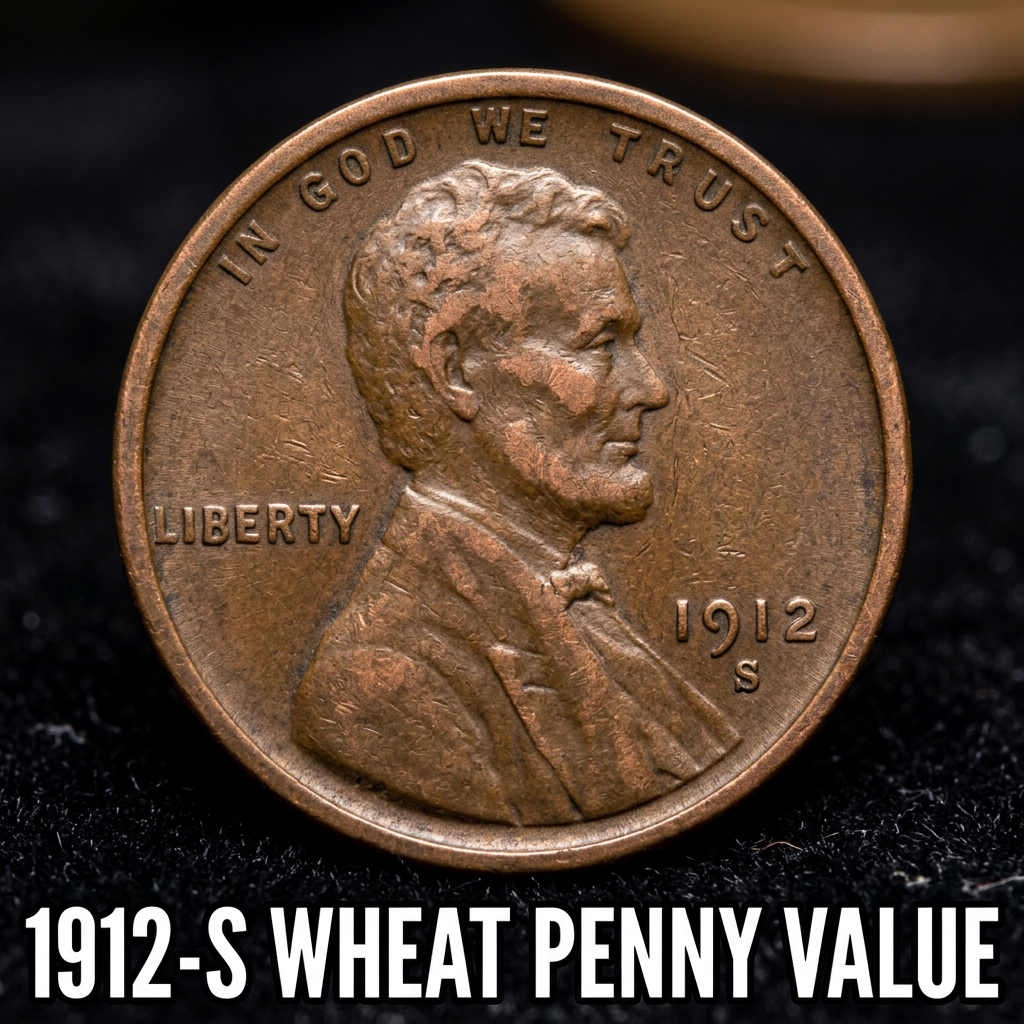
The 1912-S Wheat Penny is worth anywhere from $3 to $5 in heavily worn condition, but well-preserved examples can fetch $50, $100, or even several hundred dollars depending on grade and eye appeal. If you just dug one out of an old jar or inherited a coin collection, you’re in the right place — let’s break down exactly what you’ve got.
What Makes the 1912-S Wheat Penny Special
The “S” in 1912-S stands for San Francisco, one of three mints that struck Lincoln Wheat Pennies that year. The other two were Philadelphia (no mint mark) and Denver (D). Of the three, the San Francisco issue had the lowest mintage — just 4,431,000 coins were produced. That might sound like a lot, but for a coin that’s over 110 years old, relatively few have survived in nice condition.
To find the mint mark, flip the coin over and look at the reverse side just below the wheat stalks and above the word “ONE CENT.” If you see a small “S,” you’ve got the San Francisco issue. If there’s no letter at all, you have the Philadelphia version, which is worth a bit less in most grades.
This coin was designed by Victor David Brenner and features Abraham Lincoln on the obverse — making it the first U.S. cent to feature a real historical figure. That historical significance, combined with the lower mintage, gives the 1912-S Wheat Penny a special place in American numismatics. If you want a quick scan of what you’re holding, try using a free coin identification app to get started before diving deeper into grading.
1912-S Wheat Penny Value by Grade
Coin values are almost entirely driven by condition, also called “grade” in collector language. A coin that has been circulated heavily and shows lots of wear is worth far less than one that was saved right away and still has its original luster. Here’s a general value chart for the 1912-S Wheat Penny:
| Grade | Description | Estimated Value |
|---|---|---|
| Good (G-4) | Heavily worn, outline visible | $3 – $5 |
| Very Good (VG-8) | Moderate wear, some detail | $6 – $10 |
| Fine (F-12) | Even wear, legends clear | $12 – $18 |
| Very Fine (VF-20) | Light wear on high points | $25 – $40 |
| Extremely Fine (EF-40) | Slight wear, sharp detail | $55 – $80 |
| About Uncirculated (AU-55) | Trace wear only | $100 – $140 |
| Mint State (MS-63) | No wear, some marks | $200 – $350 |
| Mint State (MS-65+) | Gem quality, full luster | $500 – $1,500+ |
For the most up-to-date market data, you can check current 1912-S Wheat Penny auction prices and certified coin values by grade to see how recent sales compare to these estimates. Markets shift, and knowing the latest numbers matters.
How to Grade Your 1912-S Wheat Penny at Home
You don’t need to be a professional numismatist to get a rough sense of your coin’s grade. Start with good lighting — natural daylight or a bright desk lamp works well. Tilt the coin gently to catch the light from different angles. This technique, called “raking light,” helps you spot details and wear that you’d otherwise miss.
Look at Lincoln’s cheekbone and the hair above his ear. These are the highest points on the coin and the first areas to show wear. If those details are still sharp and defined, you’re likely looking at a coin grading VF or better. If the hair lines have merged into a flat, smooth surface, you’re probably in the Good to Fine range.
Also check the reverse. The wheat stalks should have clear, defined lines running through them. Soft or flat stalks are a sign of significant wear.
One thing to absolutely avoid: never clean your coin. Even a gentle rinse can leave microscopic scratches that destroy collector value. A naturally toned, uncleaned coin — even if it looks a little dark — is almost always worth more than one that’s been polished bright. CoinHix is a great resource for understanding how cleaning affects value before you make any decisions.
Red, Brown, and Red-Brown — Why Color Matters for Uncirculated Coins
If your 1912-S Wheat Penny has never been circulated, the coin’s copper color classification becomes very important. Grading services like PCGS and NGC assign one of three designations to uncirculated Lincoln cents:
– RD (Red): At least 95% of the original red copper luster remains. These are the most valuable.
– RB (Red-Brown): A mix of red and brown toning. Mid-range values.
– BN (Brown): The coin has fully toned to brown. Still collectible, but worth less than RD examples.
A gem MS-65 RD example of the 1912-S can sell for over $1,000. The same coin in MS-65 BN might bring just $300 to $400. That’s a massive difference based on one designation. For a thorough look at how these color grades impact the 1912-S specifically, this detailed breakdown of 1912 Lincoln cent values across all three mint marks and color grades is well worth reading.
The CoinHix app can also help you compare RD, RB, and BN sold examples side by side so you get a realistic picture of what buyers are actually paying.
Should You Get Your 1912-S Wheat Penny Graded?
Professional grading from PCGS or NGC costs money — typically $30 to $50 per coin for basic submissions, with premiums for faster turnaround. It only makes financial sense if your coin is likely worth more than the grading fee once certified.
As a rule of thumb: if your 1912-S Wheat Penny grades AU-55 or better, professional certification will almost certainly increase its resale value and marketability. Collectors trust certified coins, and slabbed examples consistently sell for more than raw (ungraded) ones in the same condition.
If it’s heavily worn — Good or Fine condition — don’t bother spending the money on grading. Those coins are perfectly collectible as raw pieces and are easy to buy and sell at that price point.
Still unsure where your coin lands? Use CoinHix to browse comparable certified examples and get a feel for the market before making any submission decisions.
FAQ
Q: How do I know if my penny is really a 1912-S and not a fake?
A: Genuine 1912-S Wheat Pennies were made with a distinct “S” mint mark that has a specific shape and position just below the “ONE CENT” text on the reverse. Fakes sometimes have added mint marks that look slightly off in font or placement. If the coin seems suspicious, a coin dealer can examine it in person, or you can submit it to PCGS or NGC for authentication.
Q: Is a 1912-S Wheat Penny worth more than a 1912-D or 1912 (no mint mark)?
A: In most grades, yes. The 1912-S had the lowest mintage of the three issues that year, which generally makes it the scarcest and slightly more valuable. However, all three are fairly common in circulated grades, so the difference in low-grade examples is modest. The gap becomes more noticeable in higher grades.
Q: Can I sell my 1912-S Wheat Penny online?
A: Absolutely. eBay is one of the most active marketplaces for Lincoln Wheat Pennies, and you can check completed sales to see what others have recently sold for. For raw circulated examples, local coin shops are also a convenient and quick option. If your coin is high-grade, consider having it certified first — it can make a real difference in what buyers are willing to pay.