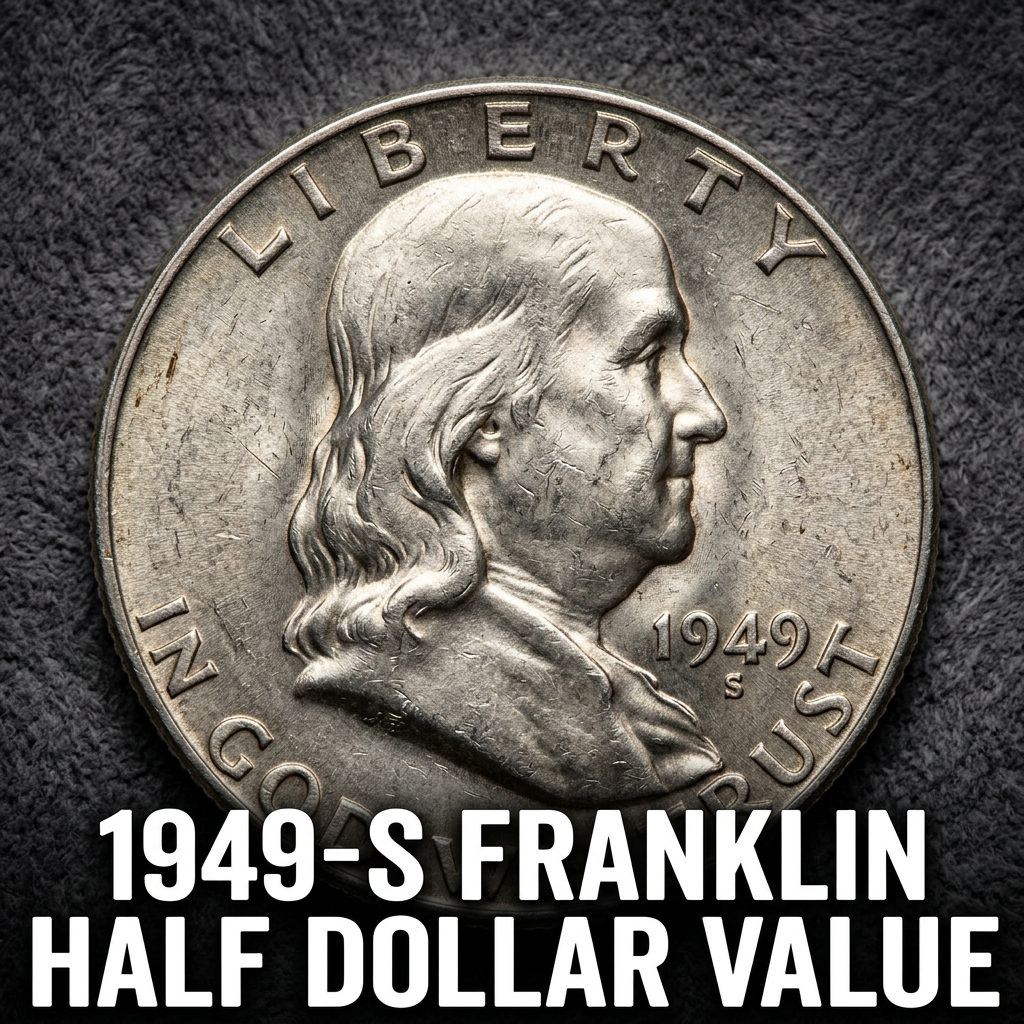
The 1949-S Franklin Half Dollar is worth anywhere from $14 in heavily worn condition to well over $500 in high-grade mint state — and certain certified examples have sold for thousands at auction. If you found one of these silver coins in an old collection or inherited it from a family member, you’re in the right place to find out exactly what it’s worth.
What Makes the 1949-S Franklin Half Dollar Special
The “S” mintmark on this coin tells you it was struck at the San Francisco Mint. In 1949, the San Francisco facility produced 3,744,000 Franklin Half Dollars — a relatively low mintage compared to the Philadelphia issue that year. Lower mintage generally means fewer coins survived in great condition, which is exactly why collectors pay a premium for high-grade 1949-S examples.
If you’re not sure whether your coin has a mintmark — or even what coin you’re holding — a free coin identification app can help you snap a photo and get answers in seconds. It’s a great starting point before you head to a dealer or auction site.
The Franklin Half Dollar series ran from 1948 to 1963. These 90% silver coins were designed by John R. Sinnock and feature Benjamin Franklin on the obverse and the Liberty Bell on the reverse. They’re a staple of American coin collecting, and the 1949-S is considered one of the more desirable dates in the series.
1949-S Franklin Half Dollar Value by Grade
Coin value depends almost entirely on condition — what collectors call “grade.” A coin that’s been sitting in a pocket for decades will look very different from one that spent its life in a protective holder.
Here’s a general value breakdown for the 1949-S Franklin Half Dollar:
| Grade | Description | Estimated Value |
|---|---|---|
| Good (G-4) | Heavy wear, design visible | $14 – $18 |
| Very Fine (VF-20) | Moderate wear, details clear | $20 – $28 |
| Extremely Fine (EF-40) | Light wear on high points | $30 – $45 |
| About Uncirculated (AU-55) | Slight friction, mostly sharp | $55 – $90 |
| MS-60 to MS-63 | Uncirculated, some marks | $100 – $250 |
| MS-64 to MS-65 | Sharp, few contact marks | $300 – $600+ |
| MS-66 and above | Gem quality, virtually flawless | $1,000 – $5,000+ |
For the most current auction results and certified coin prices, you can check out 1949-S Franklin Half Dollar prices across mint state grades on Coinhix — it’s updated regularly with real market data.
The Role of Full Bell Lines in Value
One of the most important factors specific to Franklin Half Dollars is something called “Full Bell Lines” — abbreviated FBL. This refers to the complete, uninterrupted horizontal lines at the bottom of the Liberty Bell on the reverse side of the coin.
Coins with FBL designation command dramatically higher prices. A 1949-S Franklin in MS-65 might sell for around $500 in a standard grade, but an MS-65 FBL example could easily fetch $2,000 or more. That’s a massive difference — and it all comes down to strike quality and how well the die impressed those fine details onto the planchet.
To get a coin officially graded and FBL-designated, most serious collectors send their coins to a third-party grading service like PCGS or NGC. These certified coins come in tamper-evident holders with the grade printed on the label, making them much easier to buy and sell with confidence.
CoinHix is a great tool to track what FBL and non-FBL examples are actually selling for right now, so you’re never guessing when it comes time to buy or sell.
Silver Melt Value and Why It Matters
Even a heavily worn 1949-S Franklin Half Dollar has real value — because it’s made of 90% silver. Each coin contains approximately 0.3617 troy ounces of pure silver. When silver spot prices are around $30 per ounce (as they’ve been in recent times), that gives a melt value of roughly $10–$11 per coin at minimum.
This is important to understand: your coin is never truly “worthless.” Even if it grades VG or below, the silver content acts as a floor price. That’s why old Franklin Half Dollars are sometimes bought in bulk by silver dealers, not just coin collectors.
Want a quick and reliable estimate of your coin’s current worth? The 1949 Half Dollar value guide at CoinValueApp breaks down melt value, collector value, and recent sales all in one place — very handy when you’re trying to decide whether to sell or hold.
How to Get the Best Price for Your 1949-S Franklin
If you’re thinking about selling, a few tips can make a big difference. First, don’t clean the coin — ever. Cleaning destroys the natural surface and dramatically reduces collector value, sometimes by 50% or more. Second, compare prices across multiple platforms: eBay completed sales, coin shows, and local dealers all have different buyer pools.
For casual sellers, CoinHix lets you track live pricing trends so you know when the market is strong. For higher-value coins — especially anything MS-64 or better — consider getting a professional grade from PCGS or NGC before listing. That certification can triple or quadruple the selling price.
—
FAQ
Q: How do I know if my 1949-S Franklin Half Dollar is valuable?
A: Start with the grade — look at the coin’s condition under good lighting. Check for the “S” mintmark on the reverse, above the Liberty Bell. Coins with sharp details, no wear, and Full Bell Lines (FBL) are worth the most. If it looks uncirculated, consider getting it professionally graded.
Q: Is the 1949-S Franklin Half Dollar rare?
A: It’s not the rarest date in the Franklin series, but its mintage of just under 3.75 million makes it one of the lower-production issues. High-grade and Full Bell Lines examples are genuinely scarce and much sought after by collectors.
Q: Where can I sell my 1949-S Franklin Half Dollar?
A: Options include eBay, local coin dealers, coin shows, and online auction houses. For higher-grade coins, having it slabbed by PCGS or NGC will help you get the best price. Use CoinHix to check current market values before committing to a sale price.