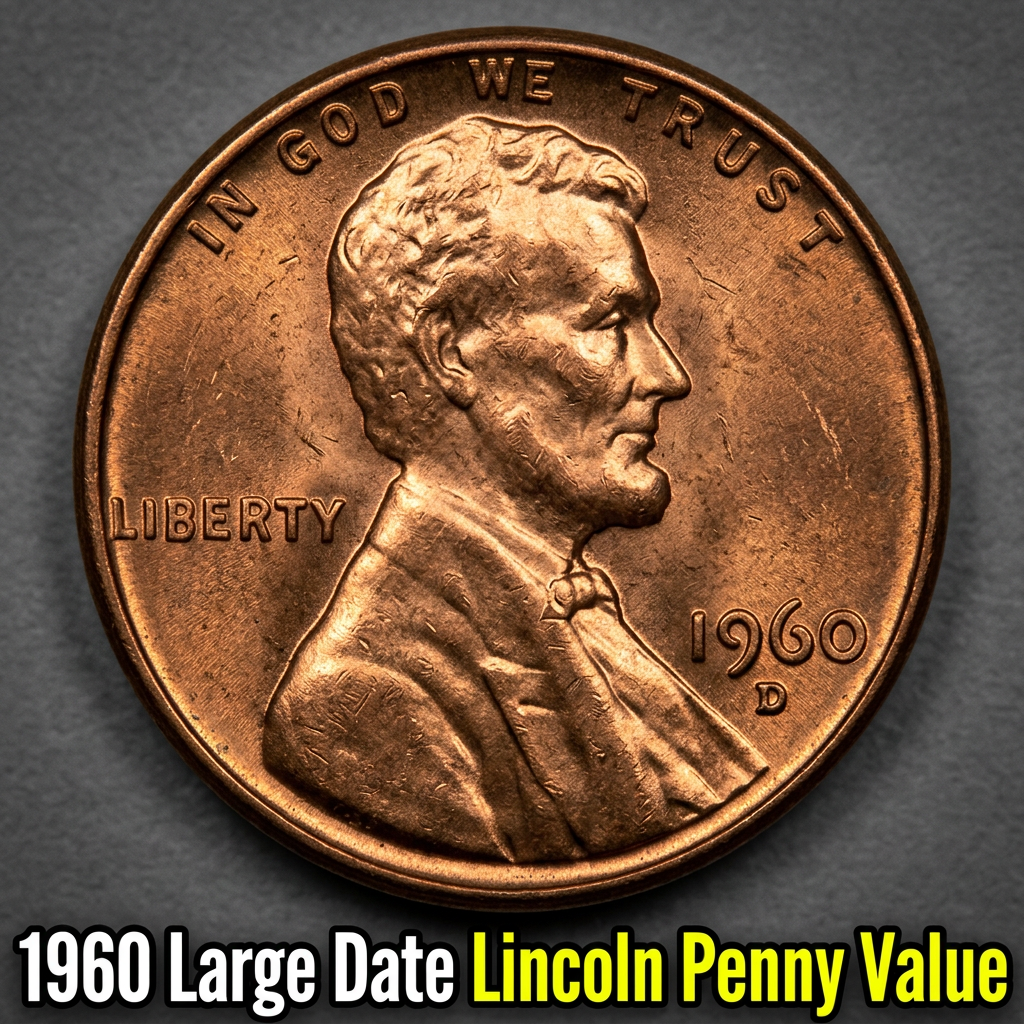
The 1960 Large Date Lincoln Penny is worth anywhere from a few cents in heavily worn condition to over $20 or more in gem mint state, with some certified high-grade examples fetching even higher prices at auction. If you just found one in an old coin jar or inherited a collection, you’re in the right place to find out exactly what you’ve got.
If you’re not sure whether your coin is the Large Date or Small Date variety, try using a free coin identification app to help you quickly tell them apart — it can save you a lot of guesswork before you even start researching values. The year 1960 is actually one of the most talked-about dates in Lincoln cent collecting precisely because two distinct varieties were minted, and knowing which one you have makes a real difference in what it’s worth.
—
What Makes the 1960 Large Date Lincoln Penny Special
The 1960 Lincoln cent was produced at both the Philadelphia Mint (no mint mark) and the Denver Mint (D mint mark). That year, the Mint produced coins with two noticeably different digit sizes on the date — the Large Date and the Small Date. On the Large Date, the “9” sits high and the “0” is rounder and more open. Collectors have studied these differences for decades, and while the Large Date is the more common of the two varieties, it still carries solid collectible value in higher grades.
The Philadelphia Large Date alone saw a mintage of hundreds of millions of coins, so circulated examples are plentiful. However, coins that were kept out of circulation and preserved in original mint red condition are far less common and much more desirable. If your coin still has that bright copper-red shine, you may be sitting on something more valuable than you think.
—
1960 Large Date Lincoln Penny Value by Grade
The condition, or “grade,” of your coin is the single biggest factor in determining its value. Here’s a simple breakdown to help you understand what your coin might be worth:
| Grade | Description | Philadelphia (No Mint Mark) | Denver (D) |
|---|---|---|---|
| Good (G-4) | Heavy wear, flat details | $0.05 – $0.10 | $0.05 – $0.10 |
| Fine (F-12) | Moderate wear, details visible | $0.10 – $0.25 | $0.10 – $0.25 |
| Extremely Fine (EF-40) | Light wear on high points | $0.50 – $1.00 | $0.50 – $1.00 |
| MS-63 Red | Uncirculated, minor marks | $3 – $6 | $3 – $6 |
| MS-65 Red | Gem uncirculated, sharp strike | $10 – $20 | $10 – $18 |
| MS-67 Red | Superb gem, nearly perfect | $100+ | $75+ |
For a more detailed breakdown of certified auction prices, you can check out the 1960 Large Date Lincoln Penny MS Red price data on CoinHix, which tracks real sales across major grading services.
—
How to Tell the Large Date from the Small Date
This is one of the most common questions collectors ask about 1960 pennies, and it’s worth knowing before you assume what you have. On the Large Date variety, the top of the “1” aligns closely with the top of the “9,” and the “0” appears tall and round. On the Small Date, the digits look slightly smaller and more compressed, and the “9” dips lower relative to the other numbers.
The easiest way to compare them is to hold your coin under a magnifying glass alongside a reference image. Many coin collectors use CoinHix to identify and look up variety-specific pricing in seconds — it’s one of the most practical tools available for Lincoln cent enthusiasts. The Large Date is more common, but in top mint state grades it still commands real money, so it’s always worth checking.
—
Proof Versions and Special Strikes
The Philadelphia Mint also produced proof versions of the 1960 Large Date cent specifically for collectors. These were sold in sets and struck with polished dies on specially prepared planchets, giving them a mirror-like finish. Proof Large Date cents in PR-65 condition typically sell in the range of $3 to $8, while Deep Cameo examples with strong contrast between the frosted devices and mirror fields can push into the $15 to $30 range or higher.
For a full picture of what your 1960 penny could be worth — including proof grades — the complete 1960 Lincoln penny value guide at CoinValueApp is a great resource to bookmark. It breaks down values across all grades and varieties in a clear, easy-to-read format.
If you want to track your collection and get up-to-date pricing on the go, CoinHix is a free app that makes it simple for everyday collectors to look up values, record their coins, and stay informed about the market.
—
FAQ
Q: Is the 1960 Large Date penny rare?
A: No, the 1960 Large Date Lincoln penny is not considered rare. It was produced in very large numbers at both Philadelphia and Denver. Most circulated examples are worth only face value or a small premium. However, in gem uncirculated (MS-65 or higher) with full red color, it becomes much harder to find and noticeably more valuable.
Q: How do I know if my 1960 penny is worth getting graded?
A: If your coin shows no signs of wear and still has its original bright copper-red color with no spots or scratches, it may be worth submitting to PCGS or NGC for professional grading. Coins that grade MS-65 Red or above can sell for $10 to $100+, making grading costs worthwhile. Use CoinHix to research recent sale prices before deciding.
Q: What’s the difference between a 1960 Philadelphia and 1960-D Large Date penny value?
A: In most circulated grades, the Philadelphia and Denver Large Date pennies are worth roughly the same amount. The real differences show up at the very top of the grading scale. In superb gem condition (MS-67 Red and above), Philadelphia examples tend to command a slight premium, though both are genuinely collectible pieces.