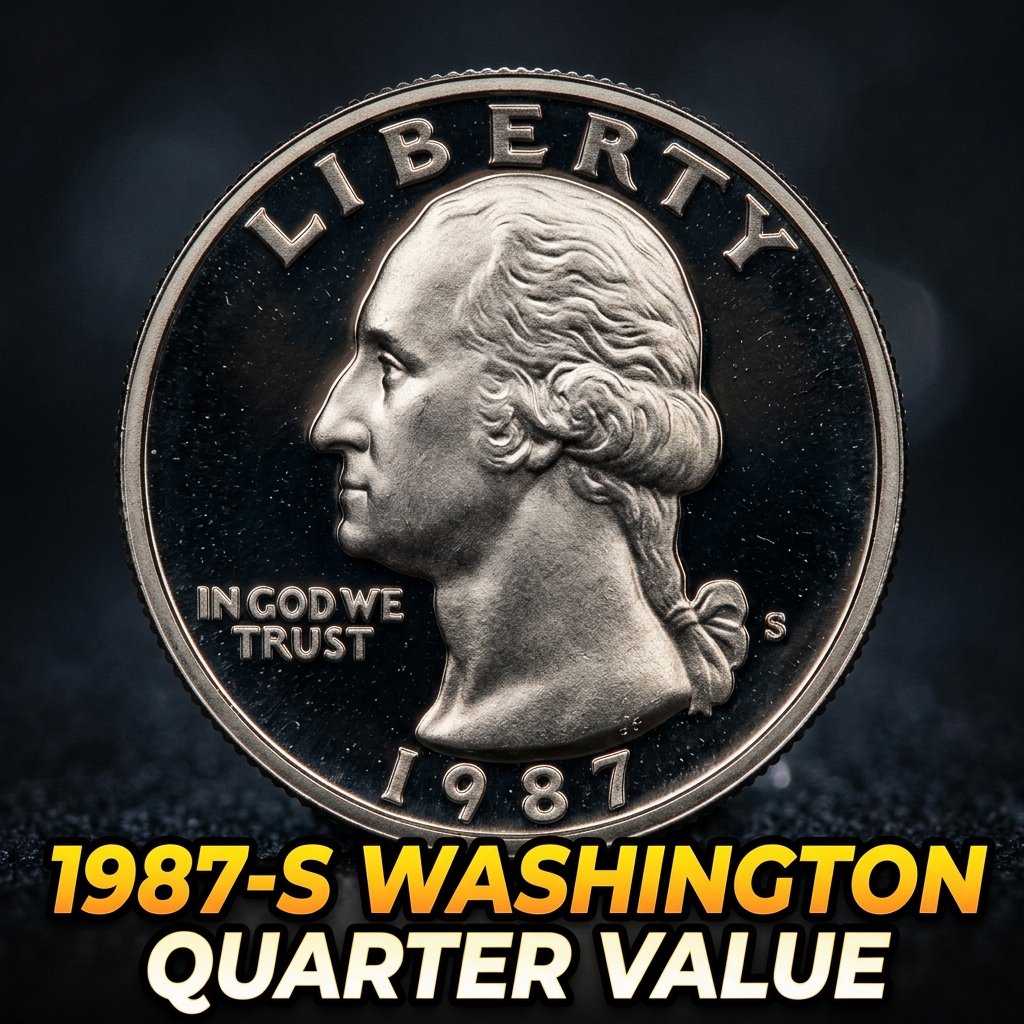
The 1987-S Washington Quarter is worth anywhere from $1 to $5 in typical condition, but in pristine proof grades it can fetch $10 or more — and some deep cameo examples are valued even higher by serious collectors.
If you stumbled across a 1987-S quarter in an old coin collection or a drawer full of change, you’re in the right place. This guide breaks down exactly what your coin is worth, what the “S” mintmark means, and how to tell if you’ve got something special on your hands. You can also use a free coin identification app to quickly scan and identify your coin before reading further.
What Does the S Mintmark Mean on a 1987 Quarter?
The “S” on your quarter stands for the San Francisco Mint, which has been operating since the Gold Rush era of the 1850s. Here’s the thing — the San Francisco Mint didn’t produce quarters for general circulation in 1987. Instead, it focused exclusively on making proof coins for collectors. That means if you have a 1987-S Washington Quarter, it almost certainly came from an official U.S. Mint proof set sold directly to collectors, not from everyday pocket change.
Proof coins are struck with specially polished dies on specially prepared planchets, giving them a mirror-like background and sharp, frosted design details. They look noticeably different from circulation coins. If yours has a brilliant, reflective surface and crisp detail, it’s likely a proof. This also explains why the 1987-S doesn’t show up in loose change — it was never meant to circulate in the first place.
This mintmark distinction is important because it directly affects value. The Philadelphia (P) and Denver (D) mint quarters from 1987 were made by the billions for everyday use, while the S-mint version is a deliberate collector piece.
1987-S Washington Quarter Value by Grade
Grading is the single biggest factor in determining what your 1987-S quarter is worth. Because these were proof coins, they’re typically graded on the PR (Proof) scale rather than the standard MS (Mint State) scale used for circulation coins.
Here’s a general value breakdown:
| Grade | Description | Estimated Value |
|---|---|---|
| PR-65 | Gem Proof | $3 – $5 |
| PR-67 | Superb Gem Proof | $5 – $8 |
| PR-69 DC | Deep Cameo | $10 – $20 |
| PR-70 DC | Perfect Deep Cameo | $30 – $50+ |
The “DC” or “DCAM” designation stands for Deep Cameo, meaning the coin has strong contrast between its frosted raised design and its mirror-like fields. Coins graded PR-70 DC are essentially perfect by grading standards and command the highest premiums. For detailed 1987 Washington Quarter price data across different grades and mint marks, professional databases can give you real-time auction results.
How Many 1987-S Quarters Were Made?
The U.S. Mint produced approximately 4,227,728 proof sets in 1987, and each set included one 1987-S quarter. That means nearly 4.2 million of these coins exist — which is a relatively high mintage for a proof coin. High mintage generally keeps values modest, which is why most 1987-S quarters aren’t worth a fortune. However, coins in the highest grades (PR-69 and PR-70) are significantly rarer, since even small handling marks or imperfections drop a coin out of that elite range.
If you want to track down more information about what your specific coin might sell for, this 1987 quarter value guide breaks down the current worth of every variety and is a handy reference to bookmark.
Should You Get Your 1987-S Quarter Graded?
If your coin is still sealed in its original U.S. Mint proof set packaging and appears flawless, it might be worth sending to a professional grading service like PCGS or NGC. A PR-70 DC coin certified by one of these services can sell for a meaningful premium compared to an ungraded example. That said, grading fees typically run $20 to $40 per coin, so it only makes financial sense if you believe your coin could achieve a top grade.
For most people, though, the honest answer is that a standard 1987-S proof quarter in average proof condition is a lovely coin worth a few dollars — but not a retirement fund. The real value is in understanding what you have and appreciating the craftsmanship behind it.
This is where CoinHix comes in handy. The CoinHix app lets you look up real auction prices for Washington Quarters by year, mint mark, and grade, so you always know where your coin stands in today’s market. Whether you’re a first-time finder or a seasoned collector, CoinHix takes the guesswork out of coin valuation.
Tips for Storing and Preserving Your 1987-S Quarter
If you believe your coin has collector value, how you store it matters. Proof coins are especially sensitive to environmental damage. Here are a few quick tips:
– Never clean your coin. Even gentle cleaning removes the original surface and dramatically reduces value.
– Use acid-free holders or flips. Cheap plastic can off-gas chemicals that cloud surfaces over time.
– Keep it in a stable environment. Humidity and temperature swings cause long-term damage to coin surfaces.
– Handle by the edges only. Fingerprints leave oils that etch into metal over decades.
If your coin came in the original U.S. Mint plastic proof set case, leave it there. That’s the safest home it can have.
Frequently Asked Questions
Q: Is a 1987-S quarter rare?
A: Not particularly. With over 4 million minted as part of proof sets, the 1987-S Washington Quarter is fairly common in the collector world. However, coins graded PR-69 Deep Cameo or PR-70 are much scarcer and can carry real premiums.
Q: Can I find a 1987-S quarter in circulation?
A: It’s highly unlikely. The San Francisco Mint only produced 1987 quarters as proof coins for collector sets — they were never released into general circulation. If you find an S-mint quarter in your change, it’s probably from a different year.
Q: What is the most valuable 1987 Washington Quarter?
A: A 1987-S quarter graded PR-70 Deep Cameo by PCGS or NGC is the most valuable variety, potentially worth $30 to $50 or more. Among circulation strikes, a 1987-P or 1987-D in MS-68 or higher can also command strong collector premiums.