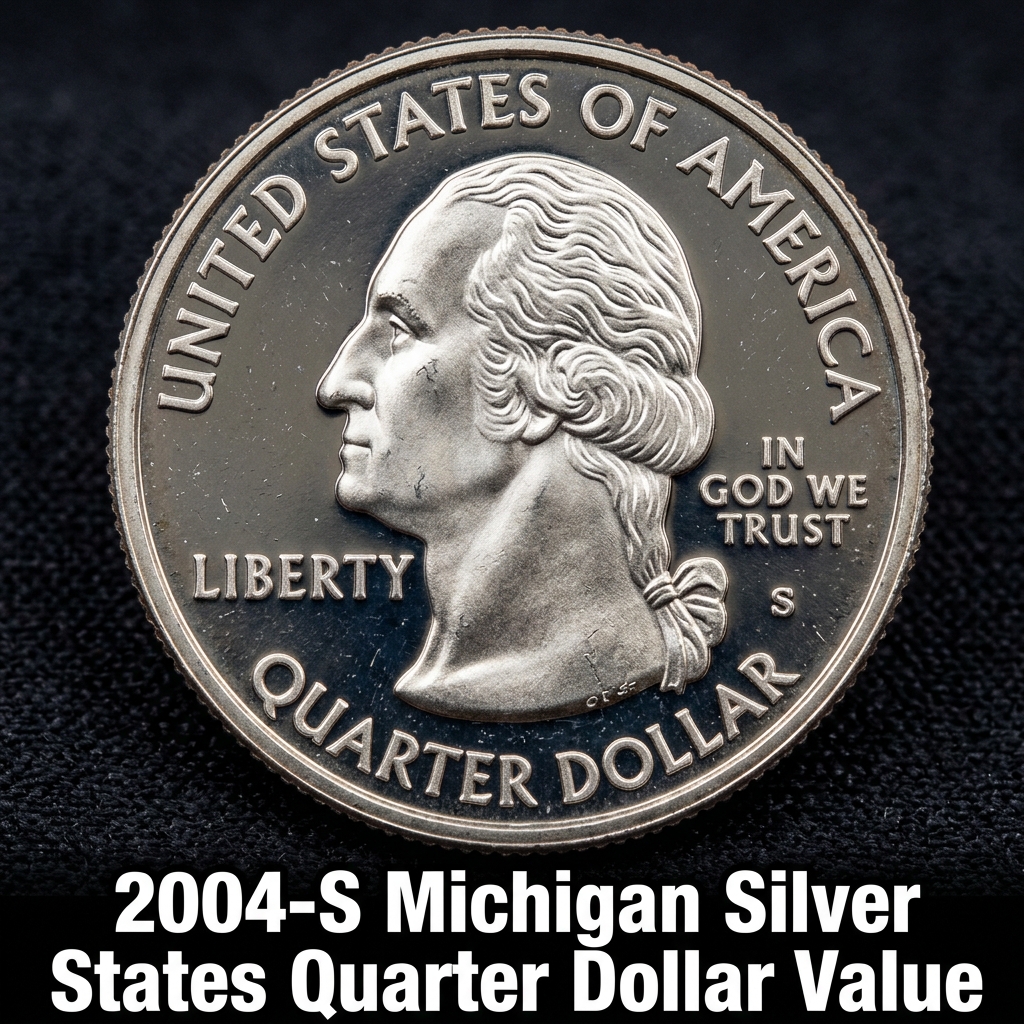
The 2004-S Michigan Silver State Quarter is worth anywhere from $5 in lightly circulated condition to over $75 or more in pristine proof grades — and some certified examples have sold for even higher. If you’ve come across one of these shiny coins, you’re in luck, because this is one of the more collectible entries in the 50 State Quarters program.
What Makes the 2004-S Michigan Silver Quarter Special
Not all Michigan State Quarters are created equal. The “S” mint mark on this coin tells you it was struck at the San Francisco Mint — and specifically, it was made as a proof coin intended for collectors, not for everyday pocket change. What really sets this version apart is that it’s composed of 90% silver and 10% copper, unlike the standard clad quarters made of nickel and copper layers.
This silver composition alone adds real intrinsic metal value to the coin. With silver prices fluctuating in the market, even a well-worn example carries melt value. But the real prize is in the proof quality. These coins were struck multiple times with specially polished dies, producing sharp details and mirror-like fields that make the design truly pop.
The design itself features a detailed outline of Michigan’s Lower Peninsula surrounded by the Great Lakes — a clean and recognizable image for Michiganders and coin collectors alike. If you’re unsure whether your coin is the silver version or the standard clad proof, a quick magnet test won’t help much, but a scale will — silver quarters weigh approximately 6.25 grams compared to the clad version at 5.67 grams. You can also use a free coin identification app to help confirm the coin’s details right from your smartphone.
2004-S Michigan Silver Quarter Value by Grade
The value of your 2004-S Michigan Silver State Quarter depends heavily on its grade — basically, how perfect it looks. Proof coins are graded on a scale from PR60 to PR70, with PR70 being a perfect, flawless coin. Here’s a general breakdown of what collectors and dealers are currently paying:
| Grade | Description | Estimated Value |
|---|---|---|
| PR60–PR64 | Minor blemishes, some contact marks | $5 – $10 |
| PR65 | Gem proof, few imperfections | $10 – $18 |
| PR67 | Superb proof, nearly flawless | $20 – $35 |
| PR68–PR69 | Near perfect, very desirable | $35 – $65 |
| PR70 DCAM | Perfect deep cameo, top pop | $75 – $150+ |
For a more detailed breakdown of certified auction results and current market prices, check out this live price data for the 2004 Michigan State Quarter across multiple grade levels — it’s one of the best ways to see what buyers are actually paying right now.
Deep Cameo vs Regular Proof — Why It Matters for Value
When shopping or selling proof coins, you’ll often see designations like “DCAM” (Deep Cameo) or “CAM” (Cameo). These terms describe the contrast between the frosted raised design elements and the mirror-like background fields. A Deep Cameo coin has a dramatic, almost three-dimensional appearance that collectors go crazy for.
A 2004-S Michigan Silver Quarter graded PR69 DCAM is worth noticeably more than a plain PR69. The DCAM designation can sometimes double the value of an otherwise identical coin. If you’re getting your coin graded by PCGS or NGC — the two most trusted grading services — always aim to have the cameo quality noted on the label, because it can make a real difference at auction.
This is where tools like CoinHix become incredibly useful. CoinHix lets you browse real-time price trends and auction histories for proof coins like this one, so you’re never guessing when it comes to buying or selling.
Should You Get Your 2004-S Michigan Silver Quarter Graded
If you believe you have a high-quality example — particularly one that looks flawless under magnification — professional grading could pay off. Submitting to PCGS or NGC costs anywhere from $20 to $50 per coin depending on the service tier, so it only makes financial sense if your coin might grade PR68 or higher.
For most people who found this coin in a proof set inherited from a family member, the coin is likely already in a plastic flip or original government packaging. That’s good! Keeping it in original mint packaging helps preserve the surfaces and may boost its appeal to buyers even without third-party grading.
For a broader look at how different 2004 quarter varieties compare in value, this comprehensive guide covering 2004 quarter values by mint mark and composition gives helpful context on where the silver proof fits in the overall picture.
You can also track values, scan coins with your phone camera, and get instant estimates using CoinHix — it’s a favorite app among everyday collectors who don’t want to spend hours researching on forums.
Where to Sell Your 2004-S Michigan Silver Quarter
If you’re ready to sell, you have several solid options. eBay is the most popular marketplace for this type of coin and gives you access to buyers nationwide. Searching completed sales for “2004-S Michigan Silver Quarter” will show you exactly what real buyers have paid recently.
Local coin dealers are another route — convenient and fast, though expect to receive 60–70% of retail value since dealers need to make a profit. Coin shows are also worth attending if you have multiple coins to sell; you can get quotes from several dealers in one afternoon.
For raw (ungraded) coins still in original proof sets, value is typically on the lower end of the range, but the silver content alone ensures you’re getting more than face value.
Frequently Asked Questions
Q: How do I know if my 2004-S Michigan Quarter is silver or clad?
A: The easiest way is to weigh it. A silver version weighs approximately 6.25 grams, while the clad proof weighs about 5.67 grams. You can also look for the “S” mint mark, but both silver and clad proofs carry the “S” — so the weight test is the most reliable method at home.
Q: What is the mintage of the 2004-S Michigan Silver State Quarter?
A: The U.S. Mint produced approximately 1,769,786 silver proof 2004-S Michigan quarters. While that sounds like a lot, the number is significantly lower than clad proofs, which contributes to this coin’s stronger collector demand and higher market value.
Q: Is a 2004-S Michigan Silver Quarter worth more if it’s still in the original proof set box?
A: Being in the original U.S. Mint packaging is generally a positive thing since it confirms authenticity and shows the coin has been protected. However, for maximum value, serious collectors prefer coins graded and slabbed by PCGS or NGC, as those certifications remove all doubt about condition and grade.