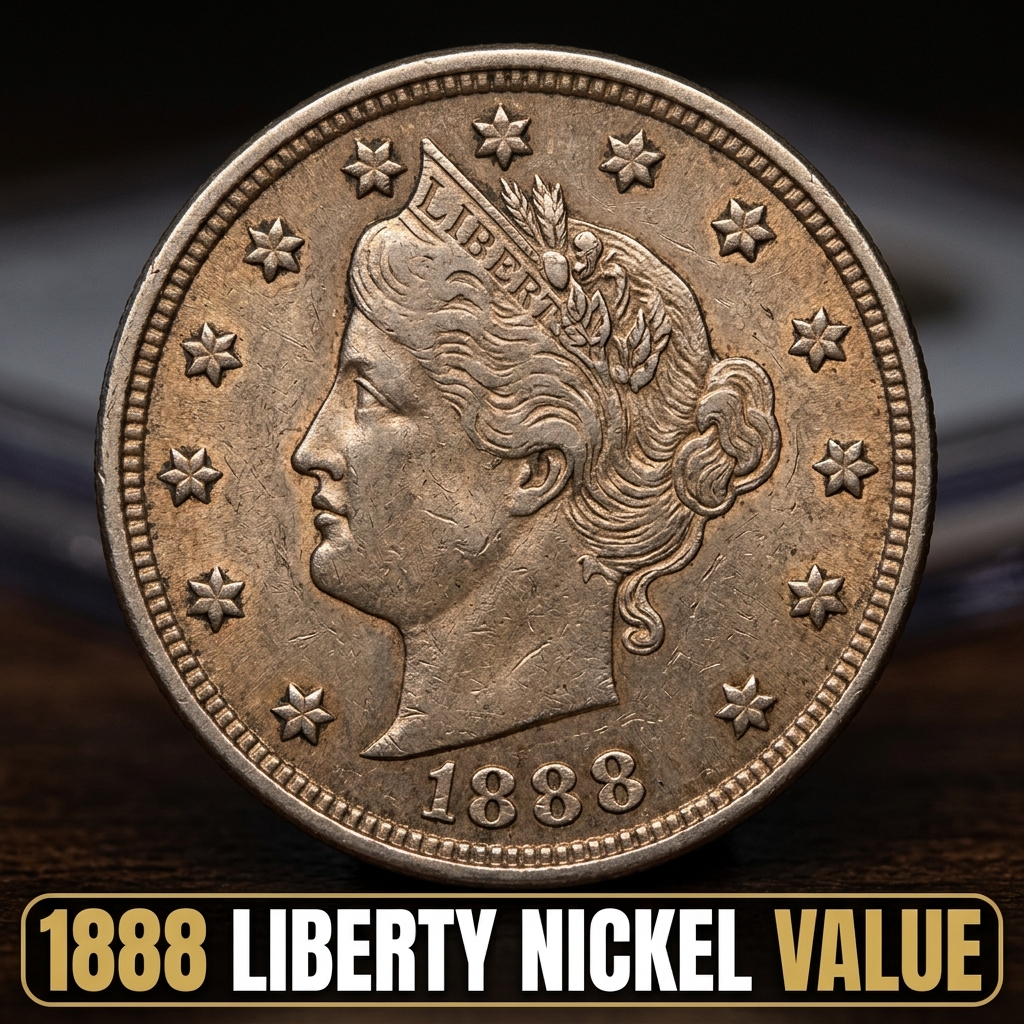
The 1888 Liberty Nickel is worth anywhere from $2 in heavily worn condition to over $200 or more in higher mint state grades. If you’ve stumbled across one of these old five-cent coins in a drawer or jar, you’re in the right place — let’s figure out exactly what you’ve got.
—
What Makes the 1888 Liberty Nickel Special
The 1888 Liberty Nickel, part of the Shield Nickel’s successor series, was struck at the Philadelphia Mint during a period when American coinage was undergoing significant changes. Designed by Charles Barber, the Liberty Head Nickel — sometimes called the “V Nickel” because of the Roman numeral V on the reverse — was a clean, elegant design that replaced the old Shield Nickel starting in 1883. The 1888 issue had a mintage of around 10,720,483 coins, which is fairly substantial, meaning circulated examples are not rare but can still be quite valuable depending on condition. If you’ve found one and aren’t sure what you’re looking at, a free coin identification app can help you confirm the coin’s date, mint mark, and series before you look up values. Knowing exactly what coin you have is the critical first step to understanding what it’s worth.
—
1888 Liberty Nickel Value by Grade
Condition is everything in coin collecting. A heavily worn 1888 Liberty Nickel where the details are nearly flat might only bring $2 to $4 at a coin shop. But as the grade improves, so does the value — dramatically. An About Uncirculated example might fetch $30 to $60, while a true Mint State coin with original luster and sharp details can push well past $100. The highest certified examples in MS-65 or above can command several hundred dollars from serious collectors.
Here’s a quick value table to give you a solid reference point:
| Grade | Description | Estimated Value |
|---|---|---|
| Good (G-4) | Heavy wear, major features visible | $2 – $4 |
| Fine (F-12) | Moderate wear, lettering clear | $6 – $12 |
| Extremely Fine (EF-40) | Light wear on high points | $25 – $45 |
| About Uncirculated (AU-50) | Slight wear, most luster present | $50 – $75 |
| Mint State (MS-63) | No wear, some contact marks | $110 – $175 |
| Mint State (MS-65) | Gem quality, strong luster | $300 – $500+ |
For the most up-to-date certified auction results and price trends, you can view 1888 Liberty Nickel mint state prices and recent sales data to see how the market is moving right now. CoinHix tracks real auction records so you’re always looking at current market values, not outdated estimates.
—
How to Assess the Condition of Your 1888 Nickel
Grading your own coin doesn’t require being a professional numismatist — you just need a good magnifying glass and some patience. Start by looking at Liberty’s hair above her ear and the laurel wreath on her head. These are the highest points on the coin and the first to show wear. If those details are sharp and fully defined, you likely have a higher-grade coin. Next, check the reverse: the Roman numeral V and the word CENTS should be crisp, not faded or mushy-looking. Hold the coin at an angle under a single light source to check for any remaining original luster — that silvery “cartwheel” effect is a good sign of an uncirculated coin. Cleaned coins are a common problem with old nickels; if the surface looks unnaturally bright or shows hairline scratches, it may have been polished, which significantly reduces collector value. CoinHix makes it easy to compare your coin’s appearance to graded examples in their database.
—
Errors, Varieties, and What to Look For
While the 1888 Liberty Nickel doesn’t have a famous major error variety like some other dates, it’s always worth examining your coin carefully. Repunched dates, die cracks, and minor varieties do exist in the series and can add a premium over standard values. A repunched date — where you can see a faint ghost of the date numerals slightly offset behind the main digits — is something collectors actively seek. Use a 5x or 10x loupe to examine the date closely. Also remember that the 1888 Liberty Nickel was only struck in Philadelphia, so there is no mint mark to look for — all genuine 1888 Liberty Nickels were made at the Philadelphia Mint. If you enjoy researching old coin values across different series, exploring detailed 1888 coin value information for other denominations from the same era can give you useful context for understanding what collectors value from that year. CoinHix also lets you search across multiple coin types in one place.
—
FAQ
Q: Is my 1888 Liberty Nickel made of silver?
A: No. The 1888 Liberty Nickel is composed of 75% copper and 25% nickel — there is no silver content. Don’t let the shiny appearance fool you. Only certain early American five-cent pieces called “Half Dimes” were made from silver, and those were discontinued before 1888.
Q: Where can I sell my 1888 Liberty Nickel?
A: You have several good options. Local coin dealers will give you a quick offer, though it may be below full market value. Online platforms like eBay or Heritage Auctions can fetch stronger prices, especially for higher-grade examples. Getting your coin certified by PCGS or NGC first can increase buyer confidence and often leads to better sale prices for nicer coins.
Q: How do I know if my coin has been cleaned?
A: Look for an unnaturally bright surface, tiny parallel scratches (called hairlines) visible under magnification, or a lack of that natural gray-toned patina that develops on old nickels over time. Cleaned coins are worth significantly less than original, problem-free examples — even if they look shinier. When in doubt, a reputable coin dealer or a grading service can give you an honest assessment.