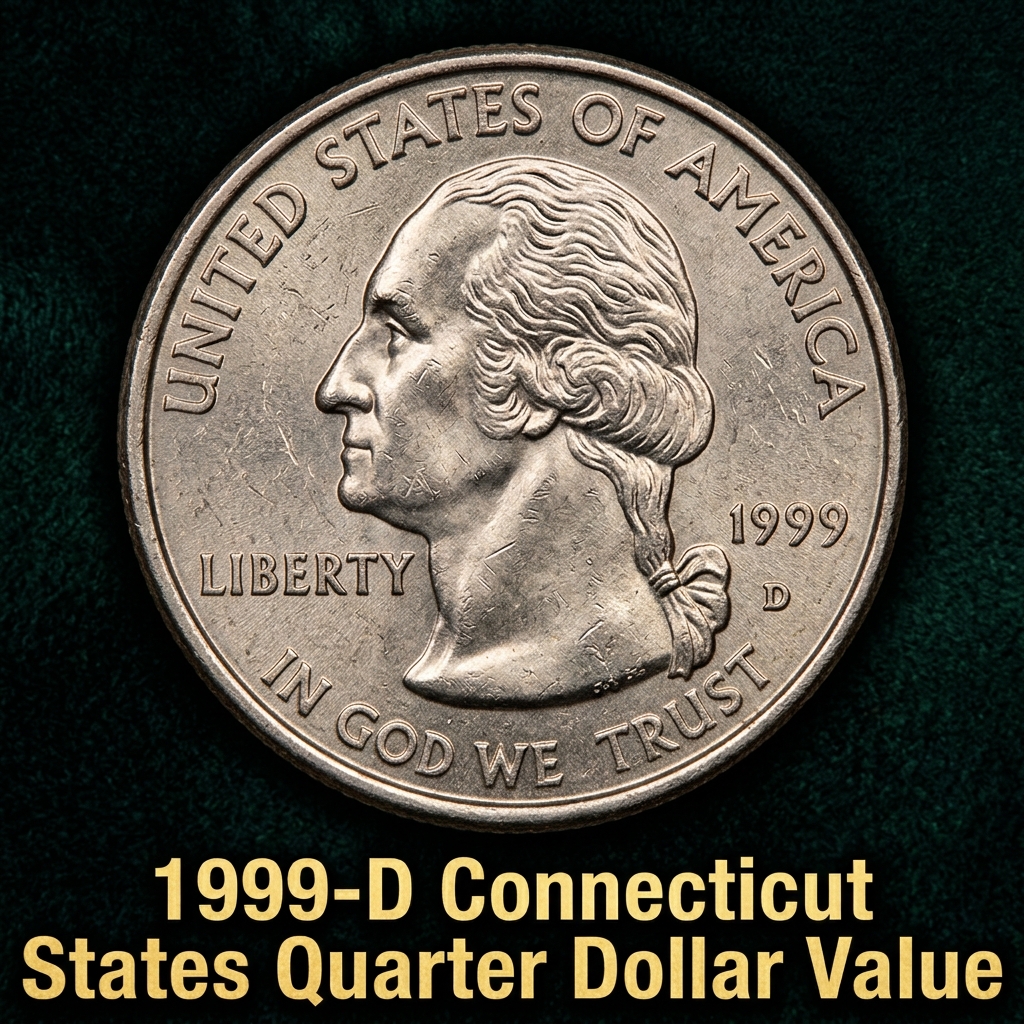
The 1999-D Connecticut State Quarter is worth between $0.25 and $25 in typical circulated condition, but high-grade examples can fetch $50 or more depending on the coin’s surface quality and eye appeal. If you found one in your change jar or inherited a coin collection, you’ve landed in the right place — let’s break down exactly what this quarter is worth and why some copies are worth far more than others.
What Is the 1999-D Connecticut State Quarter?
The 1999-D Connecticut State Quarter was struck at the Denver Mint in 1999 as part of the U.S. Mint’s 50 State Quarters Program, which ran from 1999 to 2008. The “D” mintmark — found on the obverse (heads side) just below the date — tells you it was made in Denver. Connecticut was the fifth state released in the program that year, featuring the iconic Charter Oak tree on the reverse. The design honors a legendary white oak that was said to have hidden the Connecticut colony’s royal charter in 1687. The Denver Mint produced over 657 million of these quarters, making them fairly common in circulation. However, that doesn’t mean every single one is worth face value. Coin condition, strike quality, and surface preservation matter enormously when it comes to actual market value. If you’re not sure how to identify what you’ve got, a free coin identification app can help you get started before diving deeper into grading.
How Much Is the 1999-D Connecticut Quarter Worth Today
Most circulated 1999-D Connecticut State Quarters you’ll find in pocket change are worth face value — 25 cents. Once you start moving into uncirculated grades, the value climbs noticeably. Coins graded MS65 by PCGS or NGC typically sell for $5 to $15, while those graded MS67 or above can reach $25 to $75 or more at auction.
| Grade | Description | Estimated Value |
|---|---|---|
| Circulated (G–VF) | Worn with visible details | $0.25 – $0.50 |
| Extra Fine (EF–AU) | Light wear, strong details | $0.50 – $2 |
| MS63–MS64 | Uncirculated, minor marks | $2 – $8 |
| MS65–MS66 | Gem Uncirculated | $8 – $25 |
| MS67+ | Superb Gem, top of the registry | $50 – $200+ |
You can explore up-to-date auction records and certified sale prices for 1999 State Quarters by grade to see how the market has been trending. The data there can help you benchmark your coin against real-world transactions.
Error Coins and Why They Can Be Worth Big Money
One exciting aspect of the 1999-D Connecticut State Quarter series is the existence of mint error coins. These mistakes, made during the striking process, can dramatically increase a coin’s value. The most notable errors to look for include:
- Off-Center Strikes: When the die strikes the planchet off-center, leaving part of the design missing. Errors over 20% off-center can sell for $25–$100+.
- Broadstrikes: Coins struck without the collar restraint, giving them an oversized, flat appearance.
- Double Die Errors: Slight doubling visible in lettering or design elements under magnification.
- Wrong Planchet Errors: Extremely rare cases where a quarter is struck on a dime or nickel planchet.
If your coin looks unusual in any way — misaligned design, distorted edges, or strange weight — it’s worth having it examined by a professional. CoinHix is a great resource to start researching error coins and understanding what similar pieces have sold for in the collector market.
How to Grade Your 1999-D Connecticut Quarter at Home
Grading a coin at home doesn’t require a professional eye — it just requires patience and the right tools. Start by examining your coin under good lighting. A circulated coin will show flattening on the high points of the Charter Oak tree and on Washington’s cheekbone and hair. If the coin still has its original mint luster — that cartwheel sheen you see when you tilt it under light — you may have an uncirculated example worth submitting to a grading service.
For a quick value reference, this detailed breakdown of 1999 quarter values by condition and mintmark is especially helpful for everyday collectors trying to understand how condition affects price. Combine that with the CoinHix marketplace and you’ll have a solid picture of what buyers are actually paying.
Should You Get Your Coin Professionally Graded?
If you believe your 1999-D Connecticut Quarter grades MS67 or higher, professional certification through PCGS or NGC is absolutely worth considering. Fees typically run $30–$50 per coin, so it only makes sense when the potential value justifies the expense. A certified MS67 example in a PCGS or NGC holder can sell for 3–5 times more than the same coin sold raw. For coins in lower grades, skip the submission and simply enjoy the coin or sell it as-is. Not sure what grade you have? The CoinHix app makes it easy to compare your coin to graded examples and get a feel for where it stands before spending money on certification.
FAQ
Q: How many 1999-D Connecticut State Quarters were minted?
A: The Denver Mint produced approximately 657,880,000 of these quarters in 1999, making them one of the more common issues in the State Quarters series.
Q: Is the 1999-D Connecticut quarter worth more than face value?
A: In circulated condition, most examples are only worth face value — 25 cents. However, uncirculated coins in high grades (MS65 and above) can be worth $8 to $200 or more depending on the grade and surface quality.
Q: What makes a 1999-D Connecticut quarter more valuable?
A: The biggest value drivers are condition (higher mint state grades command premiums), the presence of mint errors, and original luster. Coins with full, unimpaired surfaces and strong strikes are the most desirable to collectors.