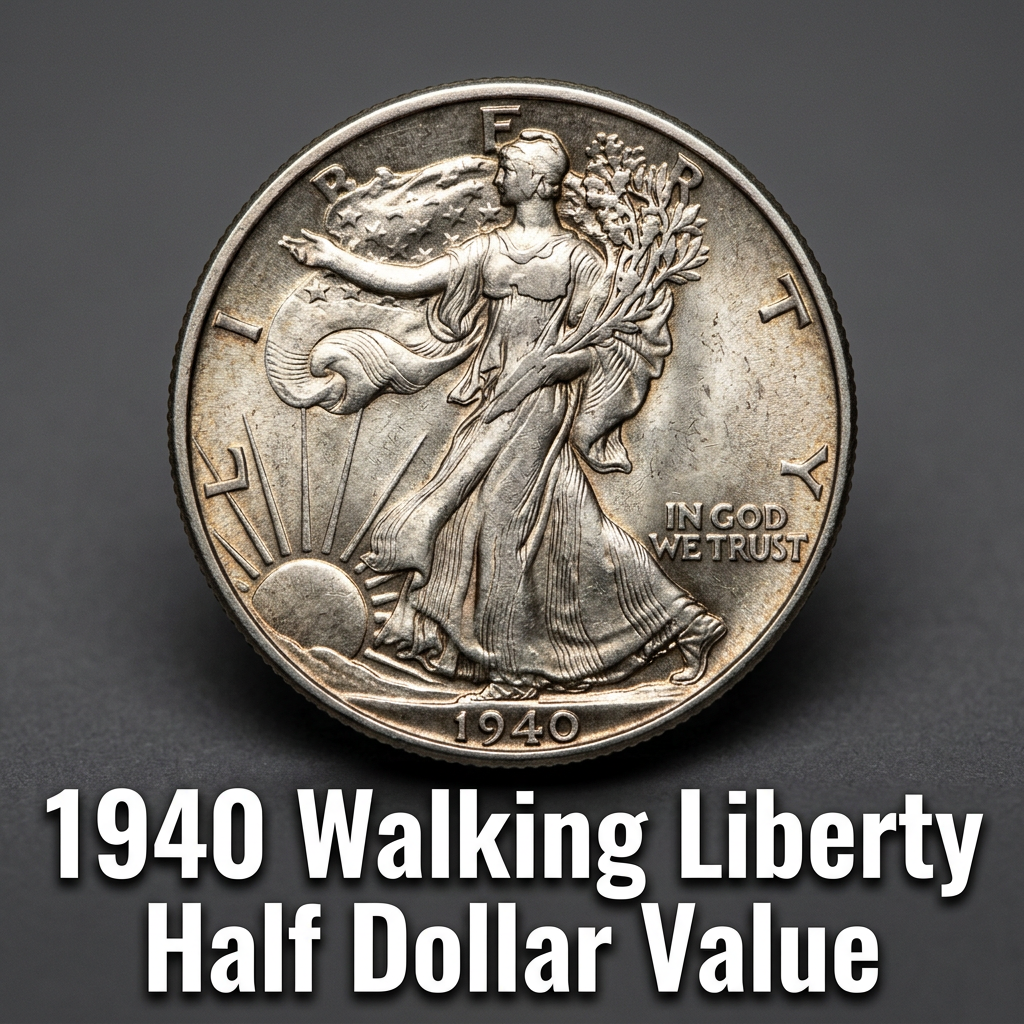
The 1940 Walking Liberty Half Dollar is worth anywhere from $12 in heavily worn condition to well over $500 in high-grade mint state — and certain rare versions can climb even higher. If you just found one of these beautiful coins in an old collection or inherited it from a relative, you’re in luck. This guide will walk you through everything you need to know about its value, mint marks, and condition grading.
What Makes the 1940 Walking Liberty Half Dollar Special
The Walking Liberty Half Dollar is widely considered one of the most beautiful coins ever produced by the U.S. Mint. Designed by Adolph A. Weinman and first struck in 1916, the coin features Lady Liberty draped in the American flag striding confidently toward the sunrise on the obverse, while a proud eagle perches on the reverse. The 1940 issue was produced in large numbers during a period of economic recovery and pre-war uncertainty, making it a historically significant piece.
If you’re not sure whether the coin you have is a Walking Liberty Half Dollar or something else entirely, you can start by using a free coin identification app to get a quick read on what you’re holding. These tools are especially handy for everyday collectors who may not yet know the difference between coin series at a glance.
The coin is 90% silver, which means even a heavily circulated example has real melt value. With silver prices fluctuating around $25–$30 per ounce in recent years, the raw silver content in a 1940 Walking Liberty Half Dollar is typically worth around $8–$10 on its own. But the numismatic (collector) premium is where things get really interesting.
1940 Walking Liberty Half Dollar Value by Mint Mark
Three mint facilities struck the Walking Liberty Half Dollar in 1940: Philadelphia (no mint mark), Denver (D), and San Francisco (S). The mint mark appears on the obverse, just below the motto “IN GOD WE TRUST” on the left side of the coin near Lady Liberty’s hand.
Here’s a quick look at approximate values by mint mark and grade:
| Variety | Mintage | Good (G-4) | Fine (F-12) | XF-40 | MS-63 | MS-65 |
|---|---|---|---|---|---|---|
| 1940 (Philadelphia) | 9,167,279 | $12 | $14 | $20 | $65 | $175 |
| 1940-D (Denver) | 4,550,000 | $12 | $15 | $22 | $80 | $225 |
| 1940-S (San Francisco) | 4,550,000 | $12 | $15 | $22 | $85 | $275 |
For a more detailed breakdown of certified auction results and current market prices, you can check out this 1940 Walking Liberty Half Dollar price data by grade on Coinhix, which tracks real-time values across major grading tiers.
How Condition Affects the 1940 Half Dollar’s Worth
Condition is everything in coin collecting, and the 1940 Walking Liberty Half Dollar is no exception. Graders look at the high points of the design — Lady Liberty’s hand and head, the eagle’s breast feathers — to assess wear. Even minor wear drops a coin from “About Uncirculated” to a significantly lower tier and can cut value in half.
Coins graded MS-65 or higher by third-party services like PCGS or NGC command serious premiums. A 1940-S graded MS-66 has sold at auction for over $500, while an MS-67 example can fetch $1,000 or more. The Philadelphia issue in MS-67 is genuinely rare and has reached several thousand dollars at major coin auctions.
That said, the vast majority of 1940 Walking Liberty Half Dollars in circulation today grade between Fine and Extremely Fine. These are lovely coins, but they’re also common enough that values remain accessible for most collectors.
CoinHix makes it simple to look up graded coin values on the go. Whether you’re at a flea market, estate sale, or just sorting through grandma’s jewelry box, CoinHix gives you real pricing data right from your phone.
Is the 1940 Walking Liberty Half Dollar a Good Investment
For most people who discover one of these coins, it’s already a win. Even a heavily worn 1940 Walking Liberty Half Dollar is worth at least twice its face value — and usually much more. As a silver coin, it holds intrinsic value that will always track the precious metals market.
For collectors and investors, the key is buying quality. An original, problem-free example in MS-63 or better is far more likely to appreciate than a cleaned or damaged coin, no matter how shiny it looks. Avoid coins that have been polished, which destroys the original mint luster and dramatically reduces value.
If you want to see what the going rate looks like right now before buying or selling, this guide to 1940 Half Dollar values with current price estimates is a great starting point for research.
And if you’re serious about building or selling a Walking Liberty collection, CoinHix is worth downloading — it gives you instant access to updated price guides across thousands of U.S. coin types, including every date and mint mark in the Walking Liberty series.
FAQ
Q: How do I know if my 1940 Walking Liberty Half Dollar has a mint mark?
A: Look at the obverse (front) of the coin, on the lower left near Lady Liberty’s right hand, just below the motto. A “D” means Denver, an “S” means San Francisco, and no letter means Philadelphia. You may need a magnifying glass since the mint mark is small.
Q: Is a 1940 Walking Liberty Half Dollar made of real silver?
A: Yes. All Walking Liberty Half Dollars, including those dated 1940, are struck in 90% silver and 10% copper. Each coin contains approximately 0.3617 troy ounces of pure silver, giving it real melt value beyond its collector worth.
Q: Should I clean my 1940 Walking Liberty Half Dollar before selling it?
A: No — absolutely do not clean it. Cleaning removes the original surface and luster, which are critical factors in grading. A cleaned coin is considered damaged by professional graders and can lose 50% or more of its market value compared to an untouched original.