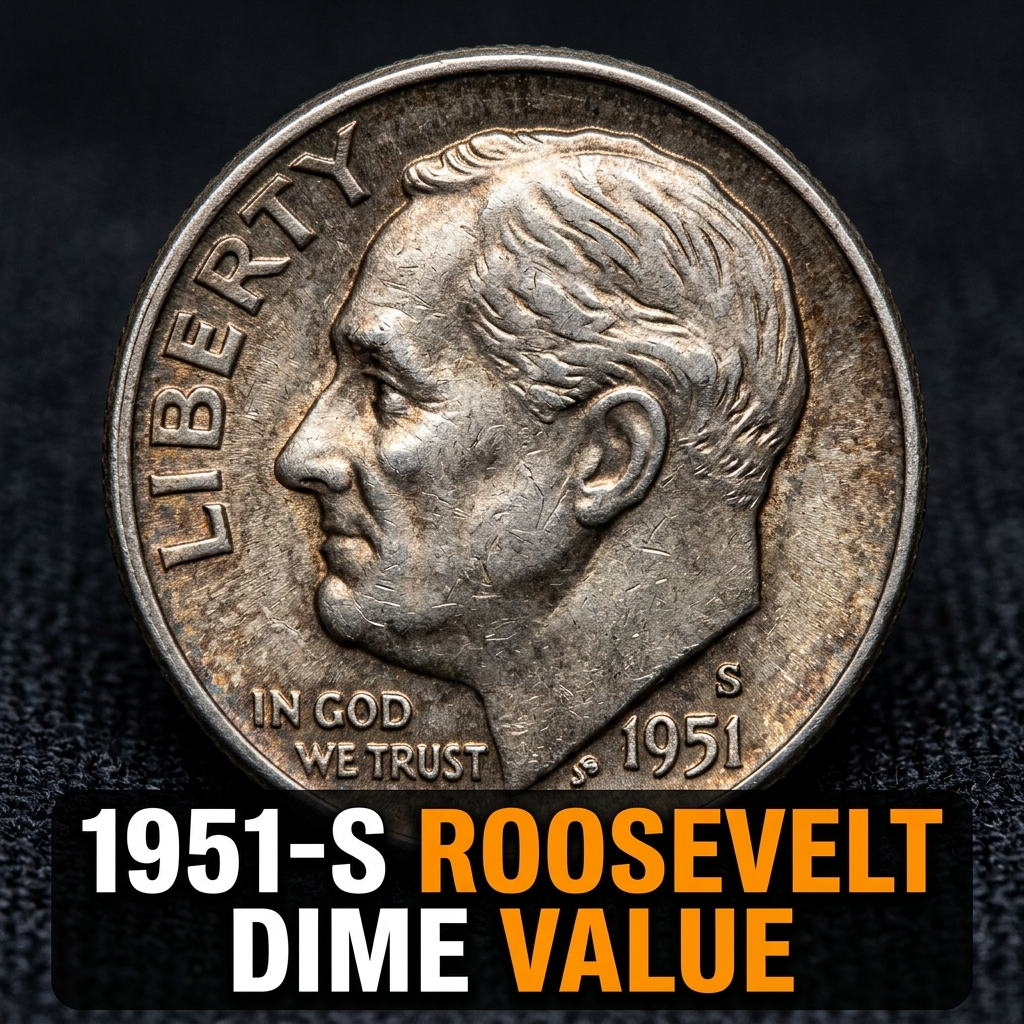
The 1951-S Roosevelt Dime is worth anywhere from $2 to $3 in heavily worn condition, all the way up to $50 or more in uncirculated grades — and top-tier examples grading MS67 or higher have sold for several hundred dollars at major coin auctions.
If you stumbled across one of these coins in an old jar or inherited a small collection, you’re in the right place. This guide will walk you through exactly what affects the value of your 1951-S dime and whether you might be holding something special.
What Is the 1951-S Roosevelt Dime?
The 1951-S Roosevelt Dime was struck at the San Francisco Mint, which is where that little “S” mintmark under the torch on the reverse comes from. That year, San Francisco produced just over 31 million dimes — a relatively modest mintage compared to the Philadelphia issue of the same year, which topped 103 million.
Roosevelt dimes were first introduced in 1946, honoring President Franklin D. Roosevelt shortly after his death, and they’ve been a staple of American pocket change ever since. The 1951-S version is made of 90% silver and 10% copper, which alone gives it an intrinsic metal value above face value. At current silver spot prices hovering around $28–$30 per troy ounce, the melt value of a 90% silver dime is roughly $2.00 to $2.20. So even a beat-up 1951-S dime is worth more than 10 cents just for its silver content.
If you want a quick identification check before diving into value research, try using a free coin identification app to confirm you’ve got the right coin and mintmark before spending time on grading.
How Condition Affects the 1951-S Dime Value
Condition — or “grade” in collector language — is the single biggest factor in what your 1951-S Roosevelt Dime is worth. Coins are graded on the Sheldon scale from 1 (barely identifiable) to 70 (perfect uncirculated). Here’s a general breakdown of what you can expect:
| Grade | Description | Estimated Value |
|---|---|---|
| Good (G-4) | Heavy wear, design outlines visible | $2.00 – $2.50 |
| Fine (F-12) | Moderate wear, major features clear | $2.50 – $3.50 |
| Extremely Fine (EF-45) | Light wear on high points | $4.00 – $6.00 |
| About Uncirculated (AU-58) | Slight wear, most luster remains | $6.00 – $10.00 |
| MS-63 | Uncirculated, minor blemishes | $15 – $25 |
| MS-65 | Gem uncirculated, strong luster | $30 – $50 |
| MS-67+ | Superb gem, exceptional surfaces | $200 – $500+ |
For the most current auction results and real-time price data, you can browse the 1951-S Roosevelt Dime certified coin prices by grade on CoinHix, which tracks actual sale prices across major platforms.
Full Strike and Bands — Why They Matter So Much
Here’s something that trips up a lot of first-time coin researchers: two 1951-S dimes can both grade MS-65 but have dramatically different values. The difference often comes down to something called “Full Bands” (FB).
On the reverse of the Roosevelt dime, the torch is wrapped with horizontal bands. On weakly struck coins, those bands blend together and lack definition. A coin designated as Full Bands (sometimes called Full Split Bands or FSB) shows complete, sharply defined separation between each band. Certified Full Bands examples consistently command a premium — sometimes two to three times the value of a non-FB coin in the same numerical grade.
When you’re looking at uncirculated 1951-S dimes, always check whether a Full Bands designation is on the holder if it’s been certified by PCGS or NGC. That small designation can be worth real money.
CoinHix is a great resource for tracking both regular and Full Bands price histories side by side so you can see exactly how much that designation adds to the value.
Is Your 1951-S Roosevelt Dime Worth Getting Graded?
If your coin looks like it has never circulated — sharp details, original luster, no obvious scratches — it may well be worth the cost of professional grading through PCGS or NGC. Grading fees typically start around $20–$40 per coin, so it only makes financial sense if you believe the coin is at least MS-65 or better.
For coins in average circulated condition, professional grading rarely adds value beyond what you’d get selling it as a raw silver dime. Most dealers and online buyers will pay silver melt value or a small premium for circulated examples.
If you’re not sure where your coin falls, CoinHix lets you browse comparable sales so you can get a realistic sense of the market before spending money on submission. You can also check out the detailed 1951 dime value breakdown by mint and condition for a broader look at how the S-mint coin stacks up against its Philadelphia and Denver counterparts from the same year.
Where to Sell a 1951-S Roosevelt Dime
Selling options depend on the coin’s grade. For circulated examples, most coin dealers will buy them as junk silver by weight — quick and easy. For nicer pieces, eBay is active with Roosevelt dime buyers, and you can use recent “sold” listings to benchmark your coin’s value. If it’s a certified high-grade piece, major auction houses or online platforms like Stack’s Bowers can reach serious collectors.
When preparing to sell, always photograph both sides in good lighting and note any special designations. The more information you provide, the better price you’ll likely get. Using CoinHix to pull up recent comparable sales gives you solid negotiating data when dealing with dealers or online buyers.
FAQ
Q: How do I know if my 1951-S Roosevelt Dime is silver?
A: All Roosevelt dimes minted from 1946 through 1964 are made of 90% silver. If your dime has a date of 1951 and shows the “S” mintmark, it is definitely a 90% silver coin. You can also do a quick edge test — silver coins show a solid silver edge, while post-1965 clad dimes show a copper core stripe.
Q: What is the most valuable 1951-S Roosevelt Dime ever sold?
A: The highest-grade examples, typically certified MS-67 Full Bands by PCGS or NGC, have sold at auction for several hundred dollars. A PCGS MS-67 FB example sold for around $400–$500 in recent years, though prices fluctuate with collector demand. Population reports from PCGS and NGC can tell you how rare your specific grade is.
Q: Can I find a 1951-S dime in circulation today?
A: It’s very unlikely but not impossible. Most silver Roosevelt dimes were pulled from circulation decades ago by collectors and silver stackers, especially during the silver price spikes of the 1980s. If you do find one in a coin jar, at an estate sale, or in an old piggy bank, it almost certainly has more than face value — at minimum its silver melt value of around $2.