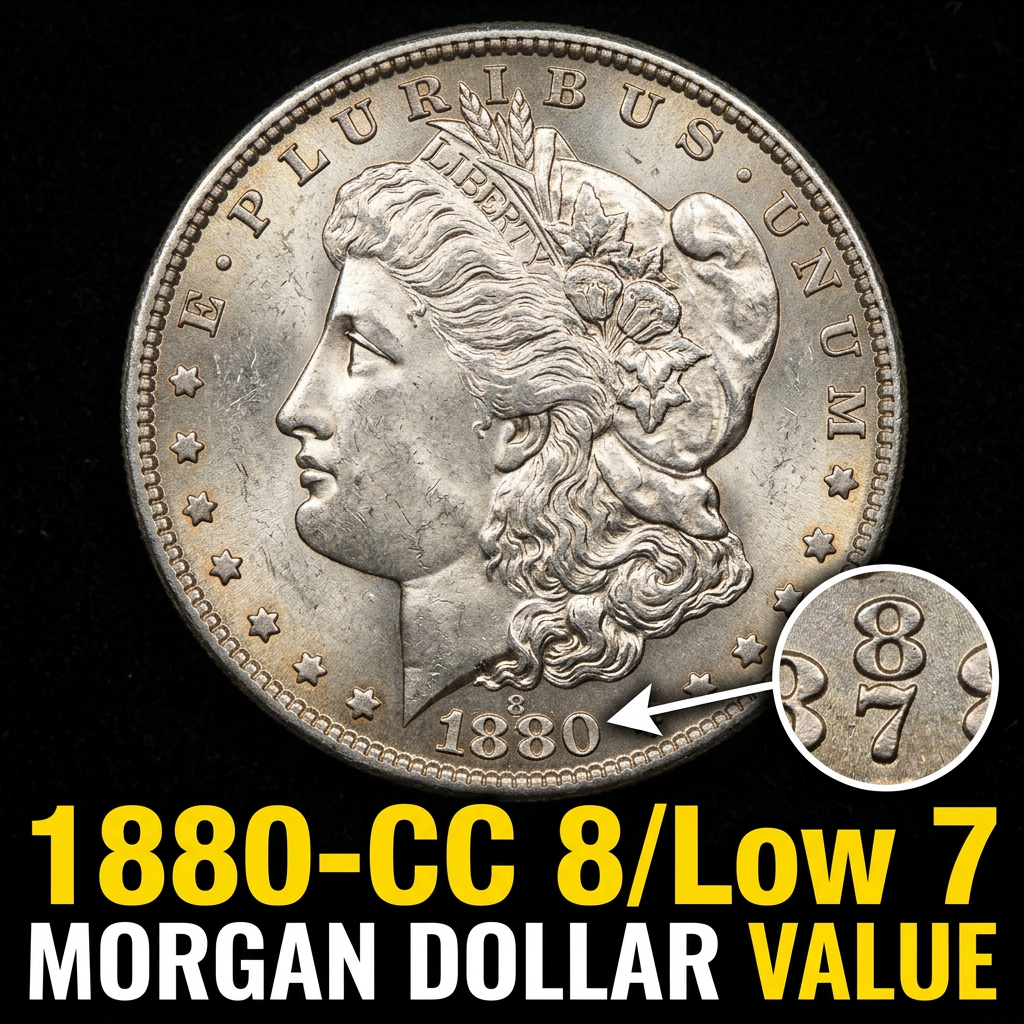
The 1880-CC 8/Low 7 Morgan Dollar is worth anywhere from $200 in heavily worn condition to well over $2,500 or more in higher mint state grades — making it one of the most exciting Carson City Morgan varieties for collectors and everyday coin finders alike.
If you recently came across an old silver dollar and think it might be one of these, you’re in the right place. This guide will walk you through what makes this coin special, how to identify it, and what it’s realistically worth today. You can also use a free coin identification app to get a quick look at your coin before diving deeper into research.
What Makes the 1880-CC 8/Low 7 Morgan Dollar So Special
The 1880-CC Morgan Dollar was struck at the Carson City Mint in Nevada, which already gives it a built-in collector premium. But the “8/Low 7” variety makes it even more desirable. This is an overdate coin — meaning the mintage die originally had a “7” punched into it (likely from 1877 or 1879 die preparation), and then an “8” was punched on top of it. Under magnification, you can clearly see the ghost of the lower “7” beneath the “8” in the date.
This type of die variety is called an overdate, and collectors love them because they tell a story about the minting process. The Carson City Mint was a smaller operation, and workers sometimes reused older dies to save resources. The result is a coin with a hidden detail that separates it from the millions of ordinary Morgan dollars minted during the same era. If you’re holding one of these, you may have something significantly more valuable than a standard 1880-CC dollar.
How to Identify the 1880-CC 8/Low 7 Variety
Identifying this coin requires a close look at the date. You’ll need at minimum a 5x loupe, though a 10x magnifier is better. Look specifically at the “8” closest to the left side of the date — this is where the remnants of the underlying “7” are most visible. The top serif of the old “7” typically peeks out just below and to the left of the “8.”
On the reverse, look for the “CC” mintmark below the eagle. Carson City coins are always in high demand, and the mintmark placement is usually clear even on worn specimens. The obverse features Lady Liberty with a cap and flowing hair, as standard on all Morgan dollars.
If you’re unsure about what you have, CoinHix is a great resource. The app helps you identify Morgan dollar varieties quickly and accurately, so you don’t have to guess whether you’re holding a common coin or a premium overdate variety.
1880-CC 8/Low 7 Morgan Dollar Value by Grade
Coin value depends heavily on condition, also known as grade. Here’s a general breakdown of what the 1880-CC 8/Low 7 Morgan Dollar is worth at various grades:
| Grade | Description | Estimated Value |
|---|---|---|
| G-4 (Good) | Heavy wear, outline visible | $200 – $250 |
| VF-20 (Very Fine) | Moderate wear, some detail | $350 – $500 |
| EF-40 (Extremely Fine) | Light wear on high points | $600 – $900 |
| AU-55 (About Uncirculated) | Slight wear, most luster | $1,000 – $1,500 |
| MS-63 (Mint State) | Uncirculated, minor marks | $1,800 – $2,500+ |
For the most current pricing, you can browse live 1880 Morgan Dollar price data by grade on CoinHix, which updates regularly based on auction results and dealer activity.
Factors That Affect the Value of Your 1880-CC Morgan Dollar
Beyond grade, a few other things influence what a buyer will pay:
Luster and eye appeal — A coin that looks bright and attractive will command a premium, even over one with a technically higher grade that appears dull or heavily toned.
Surface marks — Bag marks (small dings from coins rattling together in mint bags) reduce value in mint state examples.
Variety attribution — A coin that has been formally attributed as the 8/Low 7 variety by a grading service like PCGS or NGC will sell for more than one that hasn’t been officially recognized yet.
Certification — Slabbed coins (graded and sealed by a third-party service) typically sell for more than raw coins at auction and in private sales.
You can check a detailed breakdown of 1880 Silver Dollar values by variety and condition to compare where your coin fits and what similar examples have sold for recently.
Should You Sell, Hold, or Get It Graded
If you’ve confirmed that your coin is the 1880-CC 8/Low 7 Morgan Dollar, the decision to sell or hold really comes down to your goal. For most casual finders, getting a professional grade from PCGS or NGC is worth the investment — it protects the coin, officially confirms the variety, and typically increases resale value.
If you’re not ready for that step, start by downloading CoinHix to scan and record your coin’s details, track its current estimated value, and compare it to recent sales. It’s an easy first step before you talk to a dealer or submit for grading.
Frequently Asked Questions
Q: How do I know if my 1880-CC Morgan Dollar is the 8/Low 7 overdate variety?
A: Look at the date under magnification, specifically the left “8.” If you can see the tip or serif of a “7” underneath, you likely have the overdate variety. The CC mintmark on the reverse confirms it was struck at the Carson City Mint.
Q: Is the 1880-CC 8/Low 7 Morgan Dollar rare?
A: It’s not extremely rare in circulated grades, but it is a recognized die variety that commands a consistent premium over the standard 1880-CC. In higher mint state grades (MS-64 and above), it becomes quite scarce and values rise sharply.
Q: Where’s the best place to sell a 1880-CC 8/Low 7 Morgan Dollar?
A: Heritage Auctions and Stack’s Bowers are top options for higher-grade examples. For circulated coins, reputable coin dealers or eBay with good photos work well. Always get multiple offers before selling, and consider using CoinHix to track current market prices so you know what a fair offer looks like.